
Praia do Barril: The Anchor Cemetery Beach Near Tavira
Praia do Barril is a long, sandy beach at the western end of Ilha de Tavira, reached by a footbridge and a little train across the Ria Formosa lagoon. It grew up around a tuna-fishing camp, and the old fishermen’s buildings and rows of rusting anchors still sit behind the dunes. It suits families, walkers and anyone who likes a beach with some history.
Quick answer: drive to Pedras d’El Rei, just past Santa Luzia and west of Tavira, cross the footbridge, then walk about 1km across the marsh or ride the seasonal tourist train. The anchor cemetery is by the old fishing buildings, now cafés and restaurants. Barril flew a Blue Flag in 2026, has an accessible-beach flag, and had lifeguards from 1 June to 30 September.

Why go
Most island beaches in the eastern Algarve need a ferry. Barril needs only a short walk, which makes it one of the easiest ways onto the Ria Formosa barrier islands. The water usually shelves gently, and the sea here tends to be calmer and warmer than on the west coast.
Behind the beach, the old tuna camp gives the place a character most resort beaches lack. Barril has held a Blue Flag since 1987, and it’s well set up for visitors with reduced mobility.
What makes it special
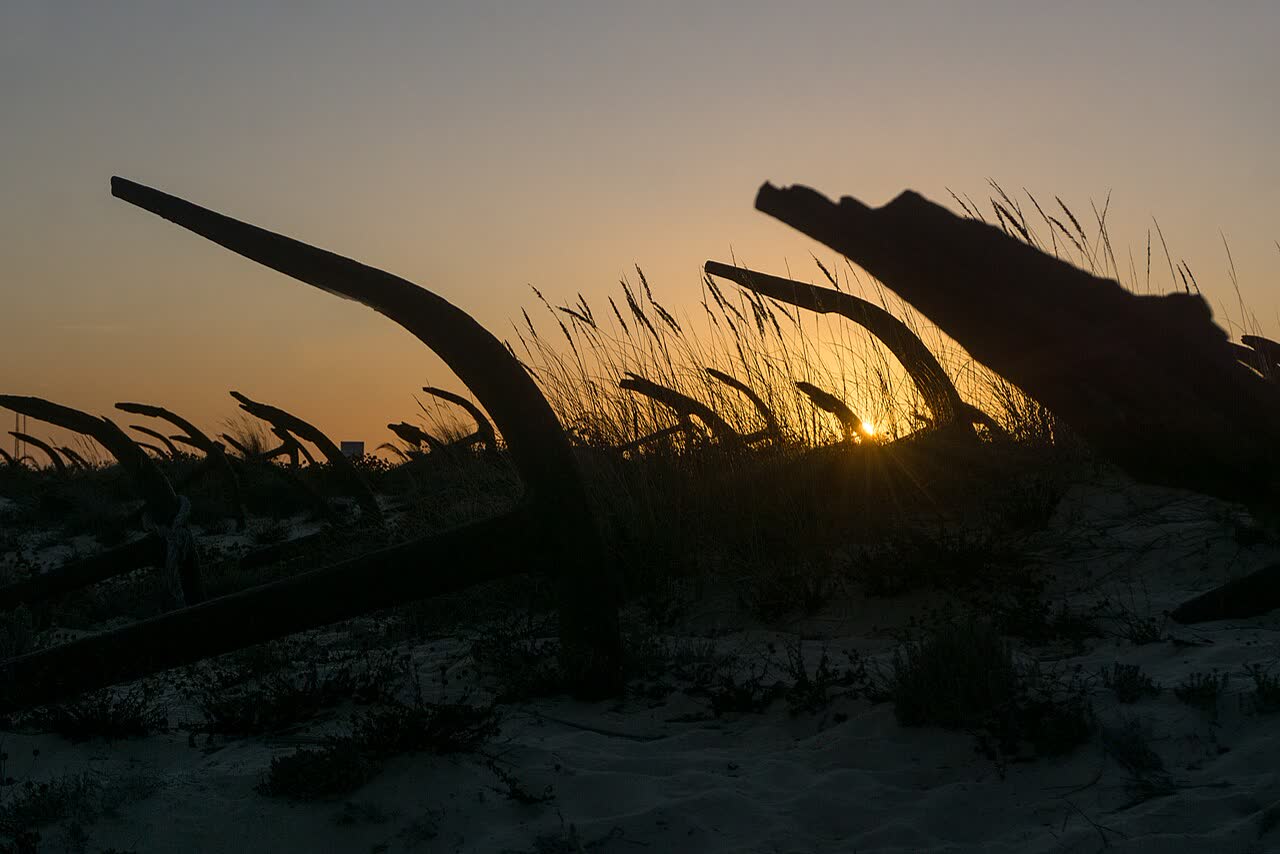
- The anchor cemetery (Cemitério das Âncoras): rows of rusting anchors lined up in the dunes, left behind when the tuna fishery closed.
- The little train across the lagoon, a hit with children.
- The old fishing camp: whitewashed buildings that now hold cafés, restaurants and the beach facilities.
- Nature: fiddler crabs on the marsh and, in the dunes, the perpétua-das-areias, a plant whose scent is often compared to curry.
The anchor cemetery and the tuna camp
For about a century, Barril was a summer base for tuna fishing. From April to September, crews set a huge fixed net, called an armação, off the beach to trap passing tuna, and the fishermen lived in the camp behind the dunes. The anchors held those nets to the seabed. When the fishery closed in 1966 they were left on the sand, and today they stand in long rows at the entrance to the beach.
Storms, shifting sand and rust have taken their toll, and some anchors are roped off, so look rather than climb. Keep to the marked paths, as the dunes are fragile.
The fishermen’s buildings now house restaurants, bars and the beach facilities. One restaurant, Museu do Atum (“tuna museum”), takes its name from those days, but it’s a place to eat, not a museum. For Tavira’s tuna dishes, see what to eat in the Algarve.
Getting there
- The footbridge: starts beside the Pedras d’El Rei resort, just west of the village of Santa Luzia, and crosses the lagoon channel onto the island.
- On foot: from the far end of the bridge, a flat path runs beside the train track for about 1km across the salt marsh to the beach, roughly 15 to 20 minutes’ walk.
- By train: a small tourist train covers the same 1km in the warmer months. The fare has been a couple of euros or less in recent years, so carry some cash and check times and prices on the day. It has room for wheelchairs and buggies, and Pedras d’El Rei guests ride free.
- From Tavira: a short drive or taxi ride. Tavira is on the Algarve railway line, but buses out to Santa Luzia are limited. See getting around the Algarve.
- Along the beach: you can also walk east along the sand to the main Ilha de Tavira beach, an hour or more. See Ilha de Tavira.
Parking
There’s both free and paid parking around Pedras d’El Rei, plus three spaces for drivers with reduced mobility about 100m from the bridge. In July and August the spaces go early, so arrive before about 10am or come by taxi. Park only in marked areas, as this is inside the protected Ria Formosa natural park.
The beach
The beach is wide and long, part of the chain of sandbar islands that shelters the Ria Formosa lagoon. It gets busy near the restaurants in summer, but walk a few minutes either way and the crowds thin out. The waves are usually small, but this is still the open Atlantic, so check the flags.
About 2km west along the sand is Praia do Homem Nu, a recognised naturist beach. It has no facilities or lifeguards, so take water and shade if you walk that far.
Facilities
- Food and drink: restaurants, bars and cafés, many closed or on shorter hours out of season. See Algarve beach restaurants.
- Toilets, changing rooms and a first-aid post, with adapted toilets.
- Hire: sunbeds, parasols and awnings in season, plus kayaks, pedalos and paddleboards.
- Accessibility: ramps, accessible routes to the sand and the facilities, and an amphibious chair for getting into the sea during bathing hours. Barril’s accessible-beach flag (Praia Acessível) went up on 16 June 2026.
- Lifeguards: on duty through the official bathing season, which ran from 1 June to 30 September in 2026. Outside it, there are usually none.
- Awards: the Blue Flag was raised again on 16 June 2026, and Barril also holds the Quercus “Gold Quality” award for its water.
When to go
- June and September: lifeguards on duty, a warm sea and more space.
- July and August: the busiest months. Arrive early for parking and the train.
- Afternoons: often breezy, and a strong easterly wind (the levante) can whip up sand and waves.
- October to May: quiet and good for walks across the marsh. The train may not run and many cafés close, so bring water and snacks.
See the best time to visit the Algarve and the eastern versus western Algarve.
Nearby
- Santa Luzia: the fishing village next door calls itself the octopus capital of Portugal. Try octopus rice or grilled octopus after a day on the sand. See the Portuguese seafood guide.
- Tavira: a few minutes away, with a castle, churches and the old arched bridge over the river, known as the Roman bridge. See Tavira and the eastern Algarve.
- Cacela Velha: a tiny whitewashed village on a bluff above the lagoon, further east. See Cacela Velha.
- The lagoon by boat: trips through the channels look for flamingos and other birds, often with an island stop. See Ria Formosa boat tours, or visit Culatra Island from Olhão.
Plan it: stay in Tavira for the old town and easy island trips: see places to stay in Tavira. Families who want the beach on the doorstep can stay at Pedras d’El Rei, right by the footbridge. Compare areas in where to stay in Tavira and the best hotels in Tavira.
FAQ
How do you get to Praia do Barril?
Drive or take a taxi to Pedras d’El Rei, just west of Santa Luzia, cross the footbridge over the lagoon, then walk about 1km or take the little train to the beach.
Does the Barril train run all year?
Not usually: it runs in the warmer months. The fare is small, a couple of euros or less in recent years, but check times and prices at the station. Out of season, the walk takes about 15 to 20 minutes.
Does Praia do Barril have lifeguards?
Yes, during the official bathing season, which ran from 1 June to 30 September in 2026. It also flew a Blue Flag and an accessible-beach flag in 2026.
Is Praia do Barril good for children?
Yes. The train, the anchors, gentle water, cafés and lifeguards in season make it one of the easiest family beaches in the Algarve. See kid-friendly Algarve beaches and the Algarve with kids.
More: Ilha de Tavira, the best Algarve beaches and the Ria Formosa natural park.
Some links in this guide are affiliate or referral links (GetYourGuide, Booking.com, Discover Cars, Welcome Pickups, Airalo, Yesim, Saily, Tiqets, Radical Storage, EKTA, AirHelp, Uber). If you book or sign up through them we may earn a small commission or ride credit at no extra cost to you. It helps keep our groups and this site free.
Still got questions?
Ask 305,000+ travellers and locals in our free Facebook groups.