
Trip guides / Destinations
The Best Beach Towns in Portugal
Looking for a seaside base in Portugal? The country’s beach towns range from whitewashed Algarve fishing villages and surf towns on the Atlantic to elegant resorts near Lisbon and island towns with golden sand. Here are the best beach towns in Portugal, what each one is like and how to reach them.
Quick answer: in the Algarve, choose Lagos, Carvoeiro, Tavira or Ferragudo. Near Lisbon, try Cascais, Ericeira or Sesimbra. On the wild west coast, Vila Nova de Milfontes and Aljezur. In the north, Nazaré and Costa Nova. For island sand, Porto Santo.
How to choose
The south coast of the Algarve has the warmest, calmest sea and the most sunshine. The west coast faces the open Atlantic, so the water is colder and the waves are bigger, which is great for surfing and less good for small children. Towns near Lisbon let you mix beach days with the city, and most are reachable by train or bus. If you don’t want to drive, pick a town with a station or a good bus link.
Think too about what you want after the beach. Lagos, Cascais and Tavira have plenty of restaurants and things to see on a cloudy day. Smaller places such as Ferragudo, Sesimbra or Milfontes are quieter, with fewer sights but more of a village feel.
The Algarve
- Lagos: coves, boat trips and a lively old town. Golden cliffs and sea stacks around Ponta da Piedade, a long sandy beach at Meia Praia and plenty of restaurants inside the old walls. Lagos has a train station. See where to stay in Lagos.
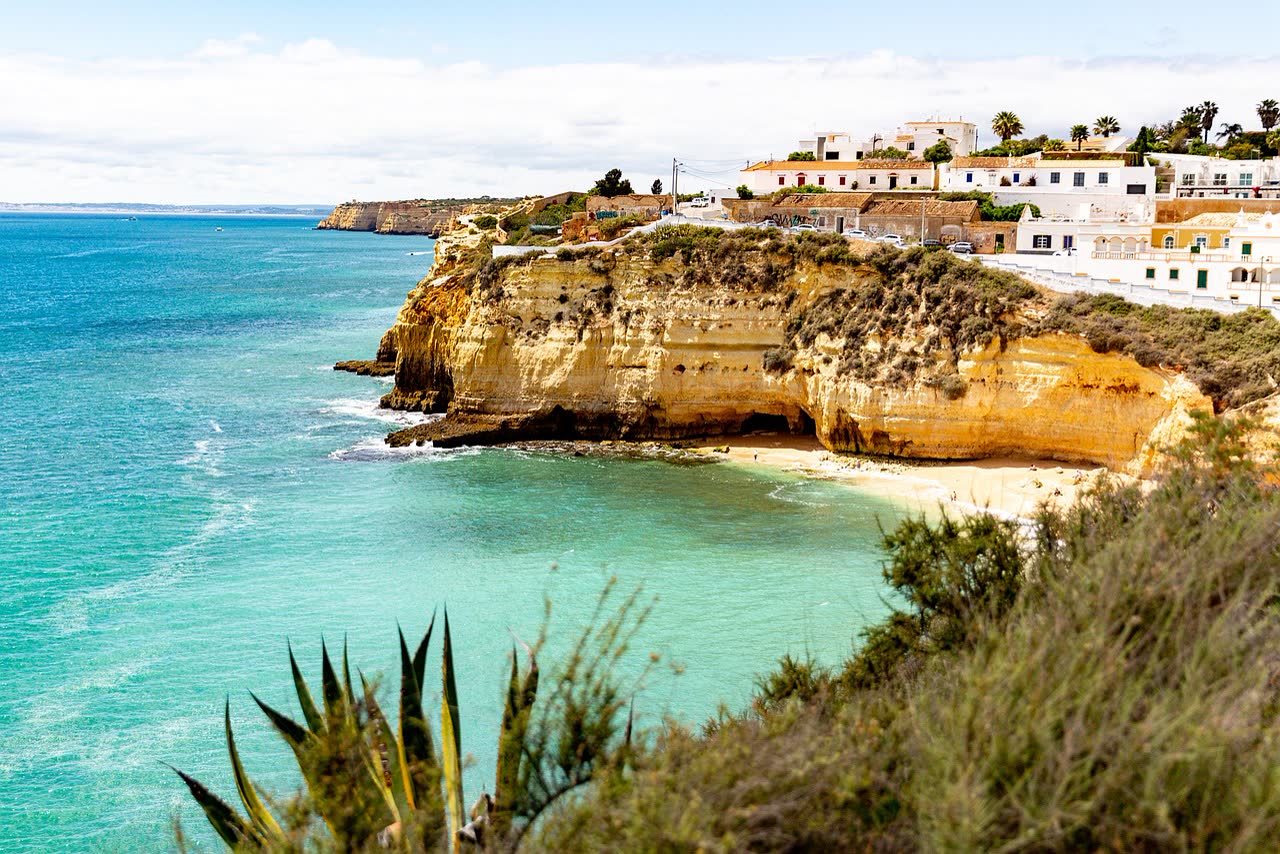
- Carvoeiro: a village wrapped around a cove. Small, pretty and close to Benagil and the Seven Hanging Valleys trail. The town beach gets crowded in August. See Carvoeiro.
- Ferragudo: a pretty fishing village. Across the river from Portimão, with a small square, grilled sardines and beaches a short walk away. See Ferragudo.
- Tavira: elegant, with island beaches. A calm town on a river, with the long sands of Ilha de Tavira a short ferry ride away. Boats leave from Quatro Águas all year, and from the town centre in summer. It also has a train station. See where to stay in Tavira.
- Alvor: a huge beach and boardwalks. Wooden walkways run through the dunes and along the lagoon, good for walks and birdwatching. See Alvor.
- Praia da Luz: a quiet bay west of Lagos. A sandy beach, a seafront promenade and cliff walks in both directions, popular with families. See Praia da Luz.
Near Lisbon
- Cascais: chic, with town beaches and Guincho. Trains from Lisbon’s Cais do Sodré take about 40 minutes and run along the coast. Because of line upgrade works in 2026, replacement buses run between Caxias and Cascais on many evenings, so check before a late trip. The town beaches are small and calm, while Guincho, a short drive or bike ride away, is windy and wild. See the best hotels in Cascais.
- Ericeira: a surf town. It was named Europe’s first World Surfing Reserve in 2011, and its white and blue houses sit on low cliffs above several beaches. Carris Metropolitana buses from Campo Grande in Lisbon take about 45 minutes to an hour. See where to stay in Ericeira.
- Sesimbra: a fishing town by the Arrábida coast. Sheltered by hills, its bay is usually calm, and the seafront is lined with fish grills. The clear water of the Arrábida beaches is close by. Parking near those beaches is very limited in summer, and the coast road from Setúbal has been partly closed since 2023, so in summer many visitors use the shuttle buses from the free park-and-ride sites near Setúbal and Azeitão. See Sesimbra and the Arrábida beaches.
The wild west coast
- Vila Nova de Milfontes and Aljezur: rivers, dunes and Atlantic beaches. In Milfontes, the River Mira meets the sea, so you can swim in calmer river water or on the ocean side. Aljezur has a hilltop castle and surf beaches such as Arrifana and Amoreira nearby. A car helps here. See Costa Vicentina.
- Comporta: rice fields and endless sand. Low-key and stylish, with wooden beach restaurants and wide beaches. Bring a car, as public transport is thin. See Comporta.
The Silver Coast and north
- Nazaré: a classic beach town. A wide sandy bay in summer, and in winter the giant waves at Praia do Norte draw big-wave surfers and crowds of spectators. A funicular climbs to the Sítio clifftop when it is running, but it closed for safety checks and maintenance in 2025 and 2026, so check before you go. Express buses run from Lisbon. See Nazaré.
- Costa Nova: striped houses and a long beach. A short hop from Aveiro, with the lagoon on one side and the Atlantic on the other. See Costa Nova.
- Viana do Castelo: beaches and kitesurfing. The Cabedelo beach across the river is popular for windsports, and the town has a handsome historic centre. Trains run from Porto. See Viana do Castelo.
Islands
Porto Santo has a 9km golden beach and calm, clear water, a contrast to rocky Madeira. Reach it by ferry from Funchal (about two and a half hours) or a short flight. See Porto Santo.
When to go
- June and September: warm, with fewer crowds than July and August.
- July and August: peak season, so book well ahead in the Algarve.
- Sea temperatures: the south coast is noticeably warmer than the west and north, where the Atlantic stays cool even in summer.
See the best time to visit the Algarve.
FAQ
Which beach town is best without a car?
Cascais is the easiest, with frequent trains from Lisbon. In the Algarve, Lagos and Tavira both have train stations and walkable centres.
Where is the sea warmest in Portugal?
Along the south coast of the Algarve, especially the eastern part around Tavira. The west coast and the north are noticeably colder, even in August.
Which beach town is best for families?
Calm south-coast towns such as Praia da Luz, Alvor and Tavira suit young children, as do Porto Santo and the sheltered bay at Sesimbra. Surf towns like Ericeira and Nazaré have bigger waves.
When is it warm enough to swim?
Most people find the sea pleasant from about late June to early October in the Algarve. Further north and on the west coast, the water stays cool all summer.
More: the best beaches in Portugal, the best Algarve beaches and Figueira da Foz.
Prices and details change, so please double-check before you travel. Spotted something out of date? Tell us in the groups.
Still got questions?
Ask 305,000+ travellers and locals in our free Facebook groups.