
Trip guides / North Portugal
Ponte de Lima: Portugal's Oldest Town
Ponte de Lima is often called Portugal’s oldest town, with a charter dating back to 1125. It’s a gentle riverside place in the green Minho, with a long medieval bridge, leafy riverbanks, manor houses and great food and vinho verde. Here’s how to visit.
Quick answer: Ponte de Lima is about 1 hour north of Porto and 30 minutes from Viana do Castelo. Walk across the medieval bridge, stroll the riverside avenue, visit on a market Monday (every other week), and eat arroz de sarrabulho with vinho verde. It’s also a stop on the Camino Português. See places to stay in Ponte de Lima.
Why go
Ponte de Lima is the oldest chartered town in Portugal: Countess Teresa, mother of the first king, granted its charter on 4 March 1125. That charter already mentions the fortnightly market, which still runs today. The town is small, green and easy to walk, with granite houses, old towers, riverside gardens and more manor houses around it than almost anywhere in the country. It’s a relaxed base for the Minho and an easy day trip from Porto.
It’s also a good contrast to the big cities. There are no major museums to queue for. Instead you get a slow walk, a long lunch and a riverbank to sit on, which is exactly why people come back.
Things to do
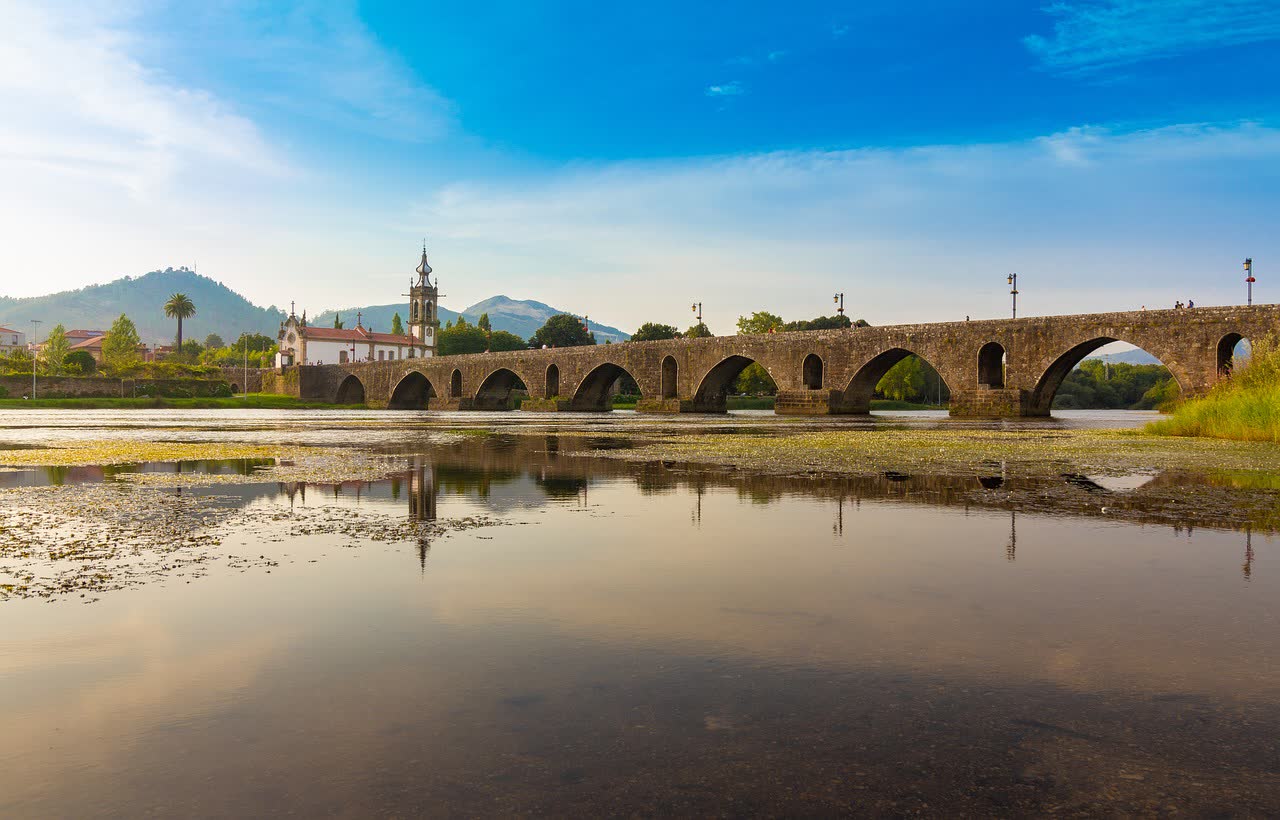
- The bridge: a long medieval bridge over the Lima, with a Roman section on the far bank. Walk across and back for the best views of the town. Allow 30 minutes.
- The old town: narrow streets, the parish church, fountains and surviving towers from the medieval walls, which were built from 1359. An hour is enough for a slow loop.
- The riverside: plane-tree avenues, gardens and a sandy riverbank, busy with picnics and sunbathers in summer.
- The market: a huge traditional fair held on the riverbank every other Monday, with produce, clothes, tools, household goods and food stalls. It’s one of the oldest documented markets in Portugal.
- The International Garden Festival: themed show gardens across the river, usually open from late spring to October.
- Manor houses: many of the region’s solares offer rural stays.
- The Ecovia do Lima: a flat cycle and walking path along the river. See cycling in Portugal.
The bridge in more detail
The bridge you walk on today is mostly medieval, built in the 14th century to replace an older Roman crossing. The Roman stretch survives on the far (north) bank, where the arches are lower and the stonework rougher. On that side you’ll also find a small church and a statue of Roman soldiers, a nod to the legend that troops feared the Lima was the mythical River of Forgetfulness and refused to cross it.
The market tips
The market is a working local fair rather than a craft market, so it’s at its best for people-watching, cheap snacks and local produce. Go in the morning, when it’s liveliest. The town hall publishes the market dates, so check which Mondays it falls on before you plan your visit around it.
The garden festival
The International Garden Festival has been held since 2005. Each year designers from Portugal and abroad build temporary show gardens on a shared theme. The 2026 edition opened at the end of May with the theme “Dream Gardens”. It’s a pleasant hour, and it suits families.
Getting there
- By car: about 1 hour from Porto, mostly on motorways, about 30 minutes from Viana do Castelo or Braga. Tolls apply. See driving in Portugal and Portugal’s tolls explained.
- By bus: Rede Expressos and other coach companies run from Porto several times a day, taking about 1 to 1.25 hours. There’s no train station. See Portugal by bus.
- Parking: there are large car parks by the river. On market Mondays they fill early, so arrive early or park further out.
- On foot: Camino pilgrims arrive from the south, then face the climb over the Serra da Labruja on the next stage.
How long to spend
Half a day covers the town. Stay a night if you want to cycle the Ecovia or explore the valley.
- Morning: the market (if it’s a market Monday), then the bridge and the riverside.
- Lunch: arroz de sarrabulho and a jug of vinho verde.
- Afternoon: the old town and the garden festival, or a ride along the Ecovia.
Food and wine
Ponte de Lima is famous for arroz de sarrabulho, a rich rice dish with pork, often served with rojões (fried pork pieces). The Lima valley is known for vinho verde, especially whites made from the Loureiro grape, and the area also makes red vinho verde. See the vinho verde guide.
Arroz de sarrabulho is a cold-weather dish made with pork, and traditionally with pig’s blood, so it’s not for everyone. If it’s not your thing, look for grilled meats, caldo verde soup and river fish on the menu. Red vinho verde is served chilled in white bowls in old-fashioned places, so don’t be surprised.
When to go
- Spring: green and fresh, and the garden festival opens.
- Summer: warm, with long evenings on the riverbank.
- September: Feiras Novas, the town’s big festival, dating back to 1826 and held around the second weekend of September (9 to 14 September in 2026, its 200th year). Expect music, folk dancing, fireworks and crowds, so book a room well ahead.
- Winter: quiet and often rainy, which is why the Minho is so green.
Nearby
- Viana do Castelo: see Viana do Castelo and the Minho.
- Peneda-Gerês: see Peneda-Gerês.
- Braga: see Braga.
- Soajo and Lindoso: granite villages and old granaries in the mountains. See Soajo and Lindoso.
- Barcelos: home of the famous rooster and a big Thursday market. See Barcelos.
FAQ
Is Ponte de Lima the oldest town in Portugal?
It’s the oldest chartered town. Its charter was granted by Countess Teresa on 4 March 1125, before Portugal became a kingdom.
When is the Ponte de Lima market?
Every other Monday, on the riverbank. Check the town hall’s dates before you go, as the fortnightly pattern means it won’t be on every Monday.
Can you get to Ponte de Lima by train?
No, there’s no station. Take a coach from Porto, which takes about an hour to an hour and a quarter, or drive.
Is Ponte de Lima worth an overnight stay?
Yes, if you want a slow pace. A night lets you enjoy the riverbank in the evening and ride the Ecovia the next morning.
More: walking the Camino Português, the most beautiful small towns and Caminha.
Some links in this guide are affiliate or referral links (GetYourGuide, Booking.com, Discover Cars, Welcome Pickups, Airalo, Yesim, Saily, Tiqets, Radical Storage, EKTA, AirHelp, Uber). If you book or sign up through them we may earn a small commission or ride credit at no extra cost to you. It helps keep our groups and this site free.
Still got questions?
Ask 305,000+ travellers and locals in our free Facebook groups.