
Trip guides / Day trips
Braga and Guimaraes: Day Trip from Porto
Braga and Guimarães are two of northern Portugal’s most rewarding cities, each under an hour and a half from Porto. Guimarães is where Portugal was born, with a castle and a perfectly preserved medieval centre. Braga is the country’s religious capital, famous for the dramatic baroque stairway of Bom Jesus. Do them separately, or both in one busy day.
Quick answer: both are on Porto’s urban train network from São Bento (about an hour to Braga and a little longer to Guimarães, a few euros). In Guimarães: the castle, the Palace of the Dukes (combined ticket €8) and the old town squares. In Braga: the cathedral, the old centre and Bom Jesus, ideally riding the 1882 water-powered funicular up and walking down the stairs. Both in one day is easiest by car or on a tour.
Getting there
- Train: urban trains run from Porto São Bento (and Campanhã) to both cities. Braga takes about an hour (55 to 70 minutes), Guimarães a little longer. Fares are low and zone-based: a single to Braga is about €3.60. There’s no direct train between Braga and Guimarães; take the bus (about 30–40 minutes).
- Car: about 50 minutes to either on the A3 or A7 (tolled), and 30 minutes between them. The easiest way to do both in one day.
- Tour: day tours from Porto cover both cities with transport and a guide. See Braga and Guimarães tours.
Train tips
- Frequency: trains to Braga usually run about every hour, more often at rush hour. Guimarães trains are less frequent, so check the CP timetable for the return before you set off.
- Which train: the urban trains are slower but cheap. Some faster Alfa Pendular and Intercidades trains also run to Braga from Campanhã for a higher fare.
- From the stations: Braga station is about 10 to 15 minutes’ walk from the centre. Guimarães station is about 10 minutes’ walk from the old town.
- See day trips from Porto by train.
Guimarães: the birthplace of Portugal
Afonso Henriques, Portugal’s first king, is said to have been born here. An old wall near the centre proudly declares “Aqui nasceu Portugal”: Portugal was born here. The historic centre is a UNESCO World Heritage Site.
In 1128, the Battle of São Mamede, fought near the town, set Afonso Henriques on the path to independence. Today Guimarães is a lively university town, and it was European Capital of Culture in 2012. You can see the main sights in half a day.
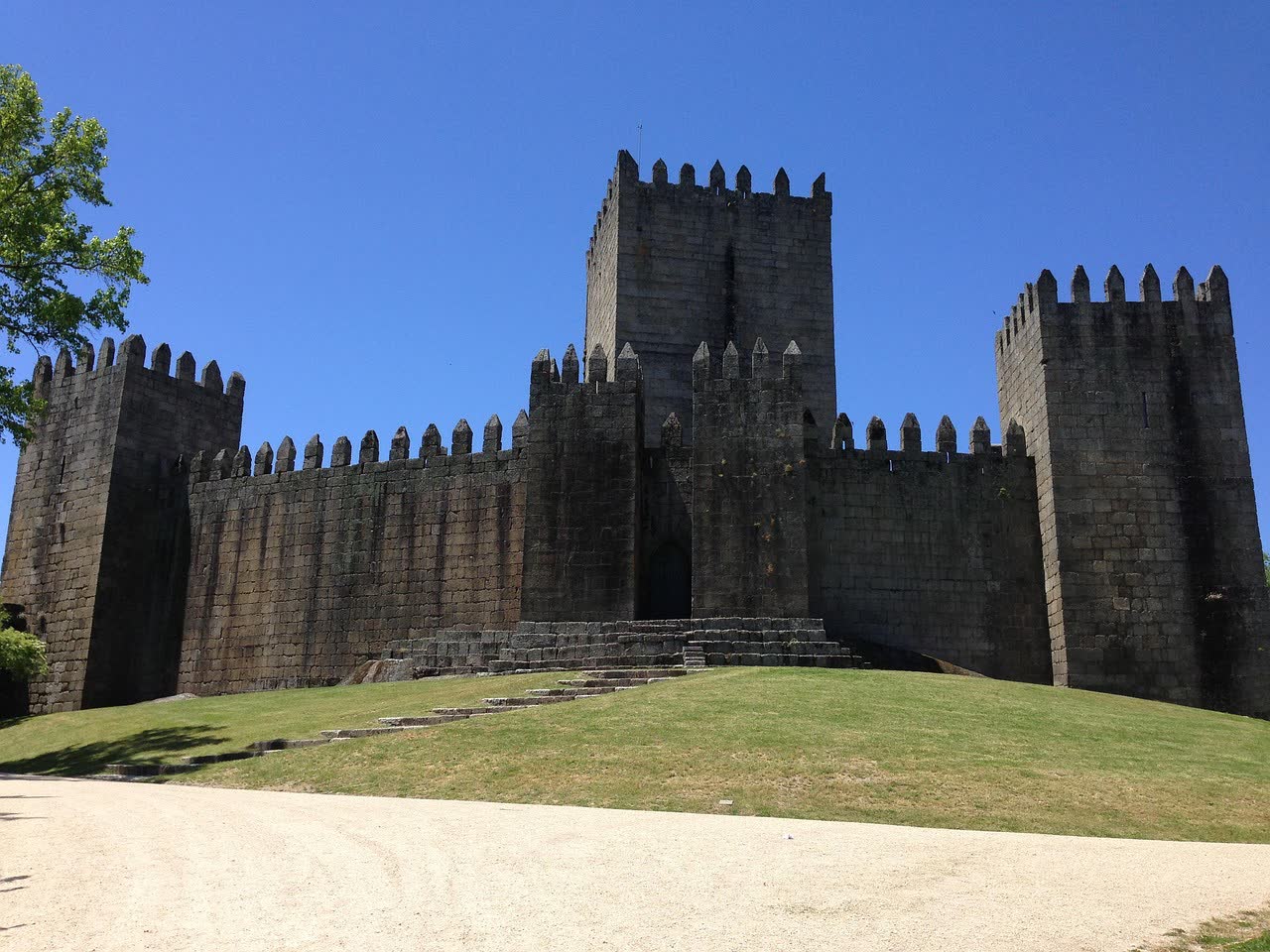
- Guimarães Castle: first built in the 10th century, with towers and a keep from the late 13th century, on a green hill. Walk the walls for views (the keep itself has been closed since works in 2024). See our Guimarães guide.
- Palace of the Dukes of Bragança: a 15th-century palace with a forest of brick chimneys, tapestries and huge halls. About €5 (some rooms are under restoration), or €8 combined with the castle. Residents of Portugal get free entry on up to 52 days a year.
- Largo da Oliveira and Praça de Santiago: two of the prettiest squares in Portugal, lined with cafes and balconied medieval houses. Lovely for lunch.
- Penha: take the cable car up the hill above town for views, woods and picnics. It was closed for long maintenance in early 2026 and has since reopened, but it still shuts for short maintenance spells, so check it’s running before you go.
The castle and palace sit next to each other at the top of the old town, beside the small Romanesque church of São Miguel, where Afonso Henriques is traditionally said to have been baptised. From there, walk down Rua de Santa Maria, one of the oldest streets in town, to the squares. The palace is usually open daily from 10am to 6pm; it closes on a few public holidays, and has also closed on 24 June, the town’s holiday, so check before you go.
Braga: Portugal’s Rome
One of the oldest cities in Portugal, founded by the Romans, with a lively student population and churches on every corner.
The Romans called it Bracara Augusta, and later it became the seat of Portugal’s archbishops, which is why there are so many churches. Today it’s a young, busy city with a pedestrian centre that’s easy and flat to walk.
Bom Jesus do Monte
The highlight, and a UNESCO World Heritage Site. A zigzag baroque stairway of 500-plus steps climbs past fountains and chapels to a church on a wooded hill, about 5km from the centre (take the city bus or a taxi). Ride the funicular, which opened in 1882 and is the oldest water-counterbalanced funicular still working in the world, up for about €2.50 (€4 return), then walk down the stairs to see them properly. The gardens, stairs and church are free.
The fountains on the stairs represent the five senses and the three virtues, and each landing has a small chapel. The funicular is short, about 270 metres, and runs frequently through the day, with longer hours in summer. At the top there’s a lake with rowing boats, gardens, cafes and big views over Braga. Allow about two hours. Our Bom Jesus do Monte guide has more detail.
In the centre
- Braga Cathedral (Sé): the oldest cathedral in Portugal, with a treasury and the twin organs.
- Jardim de Santa Bárbara: a pretty flower garden beside the medieval archbishop’s palace.
- Rua do Souto and Arco da Porta Nova: the main shopping street and the old city gate.
- Sameiro Sanctuary: a short drive above Bom Jesus, with even bigger views.
The cathedral itself is free to enter, with a fee for the treasury museum and chapels. Stop for coffee on the Avenida Central or at one of the old cafes around Praça da República, the main square.
Both in one day?
It’s doable but busy. By car: Guimarães in the morning (castle, palace, lunch in Largo da Oliveira), then Braga in the afternoon (Bom Jesus, then the centre). By public transport, pick one per day or take a tour. Better still, stay a night in either. Both are lovely and much quieter in the evening.
Sample one-day route by car
- 9am: leave Porto on the A3 or A7.
- 10am to 1pm: Guimarães castle, the palace and a walk down to the squares.
- 1pm: lunch in Largo da Oliveira.
- 2:30pm: drive to Bom Jesus (about 30 minutes) and park at the top or bottom.
- 4:30pm: Braga centre and the cathedral, then back to Porto for dinner.
When to go
Spring and autumn are the most pleasant. Braga’s Holy Week processions at Easter are the most famous in Portugal, and its São João festival on 23 and 24 June is one of the biggest in the north. Guimarães celebrates the Festas Gualterianas in early August. Summers are hot inland, and winters are cool and rainy.
What to eat
- Guimarães: toucinho do céu, a rich almond cake from the convents.
- Braga: bacalhau à Braga (fried cod with onions and potatoes) and pudim Abade de Priscos, a famous caramel pudding.
- Everywhere: a glass of fresh, slightly sparkling vinho verde. This is its home region.
Lunch is the main meal here, and many restaurants offer a good-value prato do dia (dish of the day) on weekdays. Portions in the north are big, so a half portion (meia dose) is often enough.
FAQ
How long is the train from Porto to Braga?
Urban trains from São Bento take about 55 to 70 minutes and cost about €3.60 one way. Guimarães takes a little longer, and its trains are less frequent, so check the return times.
Which is better, Braga or Guimarães?
Pick Guimarães for the castle and the medieval streets, and Braga for Bom Jesus and its churches. If you only have half a day, Guimarães is the more compact of the two.
How much is the Bom Jesus funicular?
About €2.50 one way or €4 return. The stairway, gardens and church are free, so many people ride up and walk down.
How much does it cost to visit Guimarães Castle and the palace?
The Palace of the Dukes is about €5 while some rooms are under restoration, or €8 with the castle. It’s usually open daily from 10am to 6pm, with last entry at 5:30pm.
Keep exploring the north
Continue to the mountains of Peneda-Gerês National Park, or see all our best day trips from Porto and where to stay in Porto.
See also: where to stay in Braga and Guimarães, Bom Jesus do Monte, Barcelos and the Gerês waterfalls.
Some links in this guide are affiliate or referral links (GetYourGuide, Booking.com, Discover Cars, Welcome Pickups, Airalo, Yesim, Saily, Tiqets, Radical Storage, EKTA, AirHelp, Uber). If you book or sign up through them we may earn a small commission or ride credit at no extra cost to you. It helps keep our groups and this site free.
Still got questions?
Ask 305,000+ travellers and locals in our free Facebook groups.