
Trip guides / North Portugal
Soajo and Lindoso: Granite Villages and Granaries
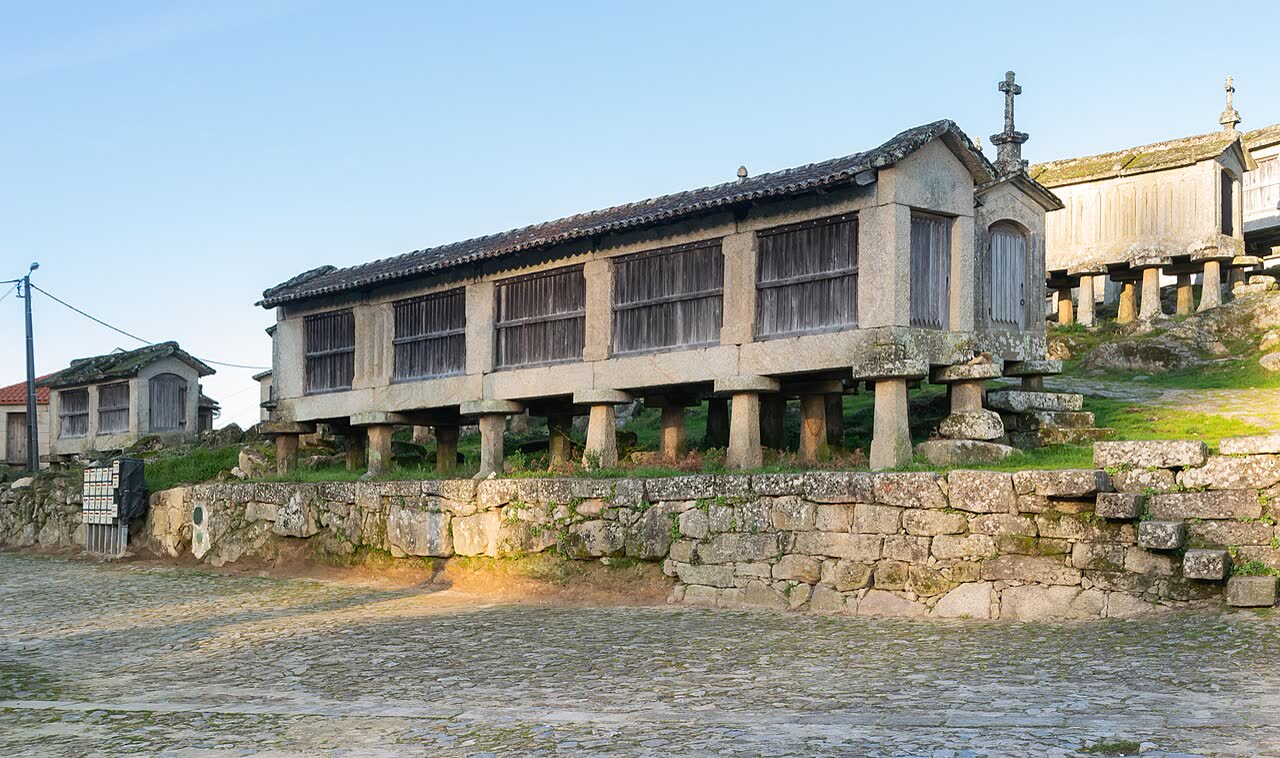
Soajo and Lindoso are traditional granite villages in the Peneda-Gerês National Park, famous for their espigueiros: stone granaries raised on stilts, clustered on rocky outcrops. Lindoso also has a medieval castle facing the Spanish border. They’re among the most photogenic places in northern Portugal.
Quick answer: both villages are about 1.5 hours from Porto, on the western side of Peneda-Gerês. See the espigueiros on the granite threshing floors, walk the village lanes, visit Lindoso castle, and swim in the river pools nearby in summer. Stay in a rural house for the full experience. See places to stay in Soajo.
.jpg)
Why go
These two villages show a way of farming life that has mostly vanished elsewhere in Europe. Granite houses, stone granaries, long-horned cattle and terraced fields sit against the mountains of Portugal’s only national park. The villages face each other across the Lima valley, only a few kilometres apart as the crow flies, so you can see both in a single day, though the road between them is slow and winding.
Soajo
Soajo belongs to the municipality of Arcos de Valdevez. Its highlight is a group of 24 espigueiros standing on a huge granite slab just above the village, which was also used as a communal threshing floor. Most date from the late 18th and early 19th centuries, and the oldest is from 1782. In the village square, look for the pillory (pelourinho), topped with a simple carved face. Tradition says King Dinis ruled that visiting noblemen could stay no longer than it took a loaf to cool on the tip of a lance. Allow an hour or two to wander.
Lindoso
Lindoso, in the municipality of Ponte da Barca, sits high above the Lima valley close to the Spanish border. More than 50 espigueiros, mostly from the 17th and 18th centuries, crowd together on a rocky platform right below the castle. Together they make one of the most striking views in the north. Allow one to two hours.
The castle was probably begun under King Afonso III in the 13th century to guard the frontier, and was modernised during the Restoration War with Spain, with the works finished around 1666.
Things to do
- The espigueiros: granite granaries on stilts, used to dry and store maize, many topped with crosses. The stilts and flat stones kept out rats and damp. Some are still used by local families, so look but don’t climb on them.
- Lindoso castle: a small 13th-century castle overlooking the Lima valley, strengthened with star-shaped bastions in the 17th century during the wars with Spain. The keep has a small exhibition, with limited opening hours, so check times locally.
- Village life: stone houses, cows and traditional farming. You’ll often meet the local long-horned cattle on the roads.
- Hiking: trails through the national park. See Peneda-Gerês.
- River pools: cool swimming spots in summer. The water is cold and conditions change after rain, so take care.
Walking between the villages
One stage of the Grande Rota Peneda-Gerês long-distance trail links Soajo and Lindoso: about 17.5km and around six hours, rated difficult. It crosses the Lima river from the Serra do Soajo to the Serra Amarela, with more than 900 metres of ascent. Start early and arrange a taxi back to your car.
On the way
- Porta do Mezio: one of the national park’s visitor gates, on the road up from Arcos de Valdevez. It has an interpretation centre and prehistoric burial mounds nearby.
- Sistelo: a tiny village in Arcos de Valdevez whose farming terraces are classified as a National Monument. Its nickname is the “little Portuguese Tibet”.
- Senhora da Peneda: a mountain sanctuary further north in the park, below a waterfall.
Getting there
- By car: the easiest option. From Porto, take the motorway north towards Ponte de Lima or Braga, then follow the Lima valley through Ponte da Barca or Arcos de Valdevez. Allow about 1.5 hours to either village. The last stretches are winding mountain roads.
- Parking: both villages have small parking areas near the espigueiros. Leave space for farm vehicles.
- Public transport: buses from Porto reach Ponte da Barca and Arcos de Valdevez, but local buses up to the villages are rare. Without a car, a taxi from either town or a guided tour is more practical. See Portugal by bus.
How long to spend
A day trip from Porto works if you start early. An overnight stay is better: you see the villages after the day visitors leave and have time for a walk in the park.
Suggested one-day route
- Morning: drive from Porto to Soajo, see the espigueiros and the village square.
- Lunch: eat in Soajo or on the way to Lindoso.
- Afternoon: drive to Lindoso, visit the castle and granaries, then return via Ponte da Barca and its old bridge.
Food
This is meat and mountain country. Look for roast kid (cabrito), local beef from the Cachena and Barrosã breeds, smoked sausages, cornbread (broa) and hearty soups. Wash it down with vinho verde, the crisp wine of the Minho.
When to go
- Spring: green fields, wildflowers and good walking weather.
- Summer: warm days for river swimming. Busiest in August. The pilgrimage to Senhora da Peneda, the biggest in the upper Minho, usually runs from 31 August to 8 September.
- Autumn: maize harvest time, with lovely colours in the valley.
- Winter: cold, wet and quiet, with mist on the hills. Some places to eat close.
These mountains get a lot of rain, so pack a waterproof in any season.
Practical tips
- Cash: carry some, as small places may not take cards.
- Fuel: fill up in Ponte da Barca or Arcos de Valdevez before heading into the hills.
- Respect: these are working villages. Close gates and ask before photographing people.
- Cattle: drive slowly, as cows and horses roam freely.
Nearby
- Ponte de Lima: see Ponte de Lima.
- Arcos de Valdevez and Ponte da Barca: riverside towns on the Lima.
- The Minho: see Viana do Castelo and the Minho.
FAQ
Can you visit Soajo and Lindoso without a car?
It’s hard. Buses from Porto reach Ponte da Barca and Arcos de Valdevez, but buses up to the villages are rare, so most people take a taxi from those towns or join a guided tour.
How far are Soajo and Lindoso from Porto?
Both are about 1.5 hours by car, via the motorway north and the Lima valley. The final stretch is slow and winding.
Can you go inside the espigueiros?
No. They are granaries, and some still belong to local families. Walk around them on the threshing floors, but don’t climb on them.
Is Lindoso castle open to visitors?
You can walk around the outside freely. The keep holds a small exhibition with limited hours, usually with a lunch break, so check times locally.
More: Portugal’s hidden gems and the most beautiful small towns.
See also: the Gerês waterfalls.
Some links in this guide are affiliate or referral links (GetYourGuide, Booking.com, Discover Cars, Welcome Pickups, Airalo, Yesim, Saily, Tiqets, Radical Storage, EKTA, AirHelp, Uber). If you book or sign up through them we may earn a small commission or ride credit at no extra cost to you. It helps keep our groups and this site free.
Still got questions?
Ask 305,000+ travellers and locals in our free Facebook groups.