
Trip guides / Day trips
The Historic Villages of Portugal: Monsanto, Piodao and More
In the hills of central Portugal, near the Spanish border, lie some of the most remarkable villages in Europe: houses squeezed under giant boulders, schist hamlets clinging to mountainsides, star-shaped fortresses and castles on granite peaks. The 12 “Historic Villages of Portugal” and the “Schist Villages” make a fantastic road trip off the beaten track.
Quick answer: don’t miss Monsanto (houses built into boulders), Piódão (a schist village on a mountainside), the castle village of Sortelha, the star fort of Almeida and Belmonte’s Jewish heritage. For the Schist Villages, see Talasnal in the Lousã mountains. You’ll need a car and 3–5 days.

Why go
This is the Portugal most visitors never see. The villages sit in the old border country of the Beiras, where castles once guarded the frontier with Spain. Many emptied out as people moved to the cities, and some now have only a few dozen residents. What’s left is granite and schist lanes, ruined castles, huge views and real quiet. It’s a world away from Lisbon and the Algarve, and most villages take an hour or two to explore, so you can see two or three in a day.
The 12 Historic Villages
The restoration programme began in 1991 with ten villages, and Belmonte and Trancoso joined in 2003. Today these 12 make up the Aldeias Históricas de Portugal: Almeida, Belmonte, Castelo Mendo, Castelo Novo, Castelo Rodrigo, Idanha-a-Velha, Linhares da Beira, Marialva, Monsanto, Piódão, Sortelha and Trancoso.
Monsanto
Often called “the most Portuguese village in Portugal”, a title it won in a national contest in 1938, Monsanto is built among, and under, huge granite boulders, with houses using rocks as walls and roofs. Climb to the ruined castle at the top for views over the plains to Spain. The climb is steep and rocky, so wear good shoes and allow two to three hours. Around 3 May, the village celebrates the Festa das Cruzes with traditional rag dolls called marafonas. Places to stay in Monsanto.
Piódão
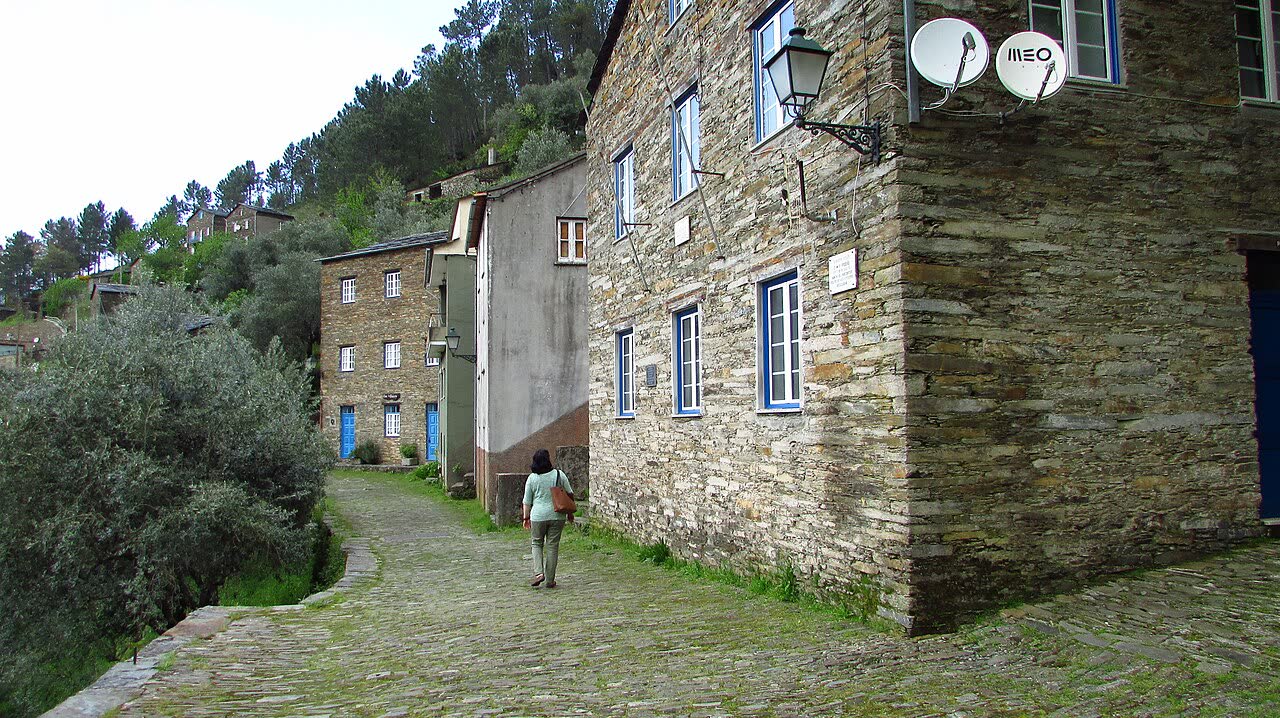
A village of dark schist houses with blue doors and windows, stacked in terraces on a steep mountainside in the Serra do Açor. Magical at night when it’s lit up. The road in is long and winding, so drive it in daylight. A marked footpath leads down to the river beach and stone bridges at nearby Foz d’Égua; allow about an hour each way. See our Piódão guide. Places to stay in Piódão.
Sortelha
A tiny medieval village enclosed by walls, with a castle perched on a granite outcrop. Atmospheric and quiet. Walk the walls for views across the valley; it takes about an hour.
Belmonte
Birthplace of Pedro Álvares Cabral, who reached Brazil in 1500, and home to a historic Jewish community that kept its faith in secret for centuries. Visit the Jewish Museum, the synagogue and the castle. Allow half a day. Places to stay in Belmonte.
Almeida
A perfectly preserved 12-pointed star-shaped fortress town near the Spanish border, with walls, moats and gates to explore. It played a big part in the Peninsular War: during the French siege of 1810, the castle was destroyed when its gunpowder store exploded. You can walk the ramparts in about an hour.
Idanha-a-Velha
A tiny village on the site of a Roman city, with Roman walls, a Visigothic cathedral and ancient remains everywhere. It’s about 20 minutes’ drive from Monsanto, so it’s easy to see both in a day.
Linhares da Beira
A granite village with a castle on the slopes of the Serra da Estrela, famous for paragliding.
Trancoso
Trancoso has a great walled old town, with a castle, gates and narrow granite lanes. King Dinis married Isabel of Aragon here in 1282. It’s one of the larger villages, with more places to eat.
Castelo Rodrigo, Marialva, Castelo Mendo and Castelo Novo
Each has a castle or fortified walls, cobbled lanes and views over wild countryside. Marialva and Castelo Rodrigo are hilltop gems near the Douro, Castelo Mendo sits on a hill near Guarda, and Castelo Novo lies on the slopes of the Serra da Gardunha.
The Schist Villages
A network of 28 villages, almost all built from dark schist stone, mostly in the mountains of central Portugal (see our Schist Villages guide). Many were abandoned and have been lovingly restored. Thirteen of them are in the Serra da Lousã, near Coimbra, where Talasnal, Candal and Cerdeira are the most beautiful, linked by hiking trails through chestnut forests. Combine with Coimbra.
Getting there
- You need a car: public transport barely reaches the villages. See driving in Portugal.
- Driving times: Monsanto is about 3 hours from Lisbon, and Almeida is about 2.5 to 3 hours from Porto. Piódão is roughly 1.5 to 2 hours from Coimbra on slow mountain roads.
- By train or bus: trains and Rede Expressos buses reach nearby towns like Castelo Branco, Covilhã and Guarda, where you can hire a car. The Beira Baixa line through Castelo Branco and Covilhã to Guarda fully reopened on 20 September 2026 after storm damage. If you come by train to Coimbra, fast trains stop at Coimbra-B.
- Parking: most villages have a car park at the entrance. Lanes inside are narrow, steep or pedestrian, so park and walk.
Planning a road trip
- Route idea: Coimbra → Piódão → Serra da Estrela → Belmonte → Sortelha → Monsanto → Idanha-a-Velha, over 3–5 days.
- One-day route: from Castelo Branco, see Monsanto in the morning and Idanha-a-Velha after lunch.
- Stay overnight in the villages to see them without day visitors.
- Best seasons: spring and autumn. Summers are hot inland, and winters cold, with snow possible in the Serra da Estrela.
- Tour: see Monsanto and village tours.
What to eat
- Queijo Serra da Estrela: the famous soft sheep’s cheese, best scooped with a spoon in winter and spring.
- Roast kid (cabrito assado) and chanfana, goat slow-cooked in red wine, a speciality around Lousã.
- Sausages and cured meats (enchidos), chestnuts in autumn and local honey.
Practical tips
- Fill up: petrol stations and cash machines are few and far between. Carry some cash for small cafés.
- Check opening times: museums and castles in small villages often close at lunchtime and on Mondays.
- Wear proper shoes: granite paths and castle climbs are uneven and slippery after rain.
FAQ
Which historic village should I visit if I only have time for one?
Monsanto, for its houses built under giant boulders and the castle views. Add Idanha-a-Velha, 20 minutes away, if you have the afternoon.
Can I visit the historic villages without a car?
Not really. Trains and buses reach nearby towns such as Castelo Branco, Covilhã and Guarda, but very few buses continue to the villages.
Are the villages free to visit?
Yes, you can wander all of them for free. Some castles and small museums charge a few euros.
Combine with Serra da Estrela and Tomar, or see our Portugal road trip and castles in Portugal.
See also: Monsanto, Guarda and skiing in Portugal.
Some links in this guide are affiliate or referral links (GetYourGuide, Booking.com, Discover Cars, Welcome Pickups, Airalo, Yesim, Saily, Tiqets, Radical Storage, EKTA, AirHelp, Uber). If you book or sign up through them we may earn a small commission or ride credit at no extra cost to you. It helps keep our groups and this site free.
Still got questions?
Ask 305,000+ travellers and locals in our free Facebook groups.