
Trip guides / Alentejo
Elvas: Portugal's UNESCO Frontier Fortress
Elvas, on the border with Spain, is the world’s largest bulwarked dry-ditch fortification. It’s a star-shaped garrison town wrapped in massive walls, with forts on the surrounding hills and a giant aqueduct. It’s a UNESCO World Heritage site that few visitors know about.
Quick answer: Elvas is about 2 to 2.5 hours from Lisbon by car and 15 minutes from Badajoz in Spain. See the walls and bastions, the Amoreira Aqueduct, the Fort of Nossa Senhora da Graça on its hilltop and the old town’s squares. Allow half a day. See places to stay in Elvas.
Why go
Elvas guarded the main road between Lisbon and Madrid for centuries, and it shows. Between the 17th and 19th centuries it was ringed with star-shaped walls, moats and hilltop forts. UNESCO listed it in 2012 as the Garrison Border Town of Elvas and its Fortifications. The walls held firm at the Battle of the Lines of Elvas in 1659, when a Portuguese army broke a Spanish siege. Today it is a quiet Alentejo town where you can walk the ramparts with hardly anyone else around.
Things to do
Fortifications
- The fortifications: walk around the star-shaped ramparts, gates and moats that once guarded Portugal’s border. A loop of the walls and main gates takes about an hour on foot.
- Forte de Nossa Senhora da Graça: a late 18th-century fort on a hill about a kilometre north of town, built between 1763 and 1792 under the Count of Lippe, who commanded the Portuguese army. It is a masterpiece of military architecture, with rings of walls around a central core and the governor’s house at its heart. After years of neglect it was restored and reopened in 2015. It’s usually open Tuesday to Sunday from 10am to 5pm (6pm from May to September). Entry is about €5, and guided visits of about 80 minutes cost a few euros more. Check times before you go, and allow one to two hours.
- Forte de Santa Luzia: a 17th-century star fort just south of the walls, linked to the town by a covered way. It houses a military museum, which is usually closed on Mondays.
- The smaller forts: the fortlets of São Mamede, São Pedro and São Domingos are also part of the UNESCO site, though you mostly see them from outside.
The town
- The Amoreira Aqueduct: a huge aqueduct carrying water into the town. It runs for about 7km, took around a century to build and was finished in 1622. Near the town it rises in up to four tiers of arches, about 31 metres high at the tallest point. You can see it from the road as you drive into town.
- Praça da República: the main square with its patterned pavement, overlooked by the former cathedral of Nossa Senhora da Assunção. The tourist office is on the square.
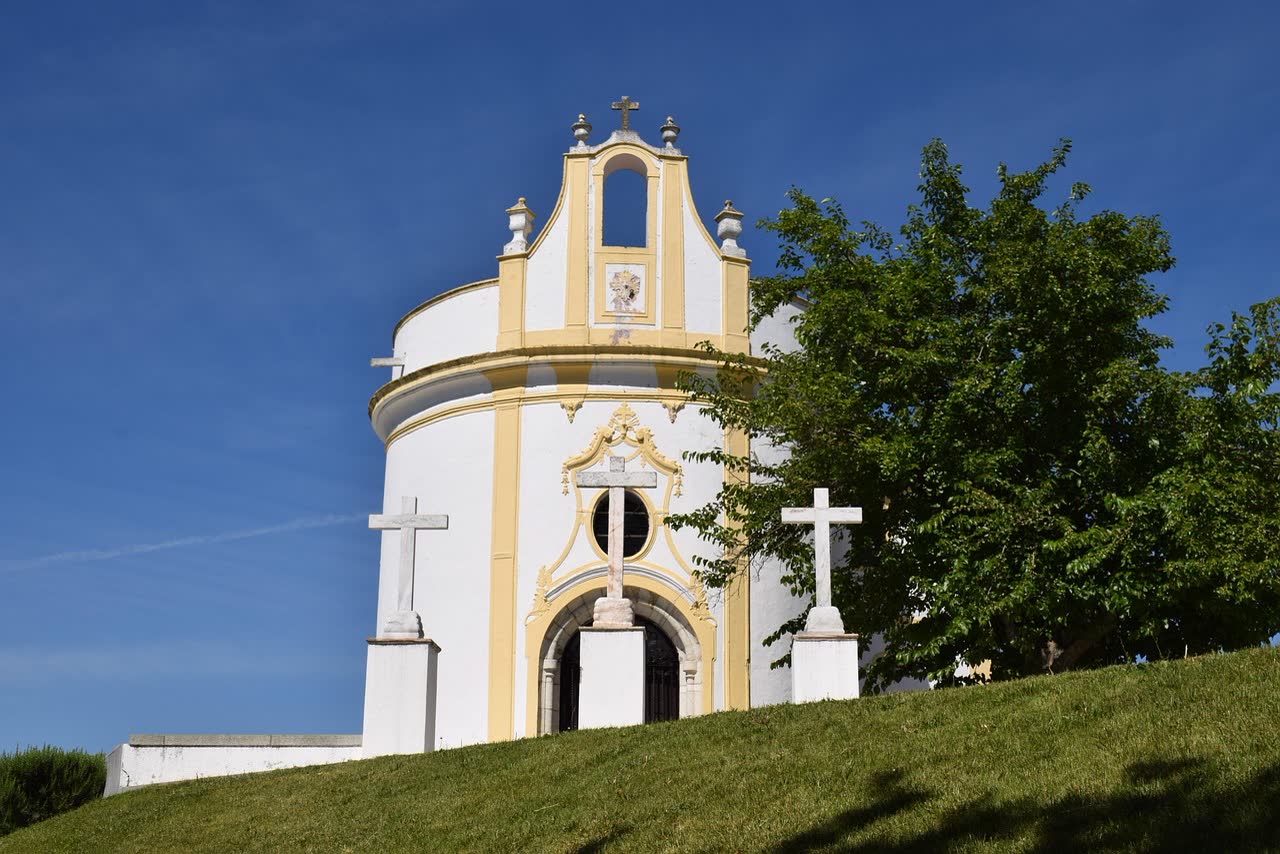
- Igreja de Nossa Senhora da Consolação: a small 16th-century octagonal church a short walk uphill from the square. Inside, 17th-century patterned tiles cover the walls, vaults and dome, with marble columns and gilded altars.
- Largo de Santa Clara: the little square outside the Consolação church, with an unusual Manueline pillory topped by iron dragon heads.
- The old lanes: small squares, churches and whitewashed streets inside the walls. Allow an hour to wander.
Getting there
- By car: roughly 2 to 2.5 hours from Lisbon on the A6 motorway, about 1 hour from Évora and around 15 minutes from Badajoz.
- By bus: coaches from Lisbon run via Évora and Estremoz. Rede Expressos serves Elvas, and the trip takes about 3 hours or more. FlixBus also runs a Lisbon to Badajoz route via Évora and Estremoz that stops here, so check both for times. See Portugal by bus.
- By train: CP runs only about two regional trains a day each way on the Linha do Leste, from Entroncamento through Portalegre to Elvas and Badajoz. Check the timetable before you plan around it. A new line from Évora to the border has been built, but passenger trains aren’t expected before late 2026 at the earliest.
- Parking: park outside the walls and walk in. The lanes inside are narrow.
How long to spend
Half a day covers the town, the walls and the aqueduct. Give it a full day if you want to visit both big forts.
A one-day route: start at the aqueduct in the morning, then enter the old town and walk to Praça da República. After lunch, walk part of the walls, then drive up to the Forte da Graça for the views over the town and into Spain. Finish at Forte de Santa Luzia. Avoid Mondays, when both forts are usually closed.
Food
- Ameixas d’Elvas: the town’s famous candied plums, often served with sericaia, a light Alentejo egg pudding.
- Alentejo cooking: black pork, lamb, bread soups and hearty stews. See Alentejo food.
- Wine: the vineyards of the Alentejo are all around.
When to go
Spring and autumn are best. Summer is very hot, and temperatures can top 40°C. The big local event is the Festas do Senhor Jesus da Piedade and the São Mateus fair, held in the second half of September with a huge procession, concerts and a traditional fair. In 2026 it ran from 18 to 27 September.
Nearby
- Badajoz (Spain): just across the border. Remember that Spain is one hour ahead.
- Estremoz and Vila Viçosa: see Estremoz and Vila Viçosa.
- Monsaraz: see Monsaraz.
- Marvão: a hilltop castle village to the north. See Marvão.
Tips
- Heat: very hot in summer. Visit in spring or autumn, or start early.
- Shoes: wear comfortable shoes for the cobbles and ramparts.
- Road trip: Elvas works well on a route between Lisbon and Spain. See the best road trips.
FAQ
Can you visit Elvas as a day trip from Lisbon?
Yes, by car. It’s about 2 to 2.5 hours each way on the A6, which leaves enough time for the walls, the aqueduct and one fort. By bus or train it’s easier to stay the night.
Can you walk to the Forte da Graça?
The fort is about a kilometre north of the walls, on top of a steep hill. Most people drive up, and walking is hard work in summer heat.
What is Elvas famous for?
Its star-shaped fortifications, which UNESCO listed in 2012, the Amoreira Aqueduct and its candied plums, ameixas d’Elvas.
More: UNESCO sites in Portugal, castles in Portugal and Portugal’s hidden gems.
See also: Lisbon to Madrid.
Some links in this guide are affiliate or referral links (GetYourGuide, Booking.com, Discover Cars, Welcome Pickups, Airalo, Yesim, Saily, Tiqets, Radical Storage, EKTA, AirHelp, Uber). If you book or sign up through them we may earn a small commission or ride credit at no extra cost to you. It helps keep our groups and this site free.
Still got questions?
Ask 305,000+ travellers and locals in our free Facebook groups.