
Trip guides / Alentejo
The Chapel of Bones in Evora
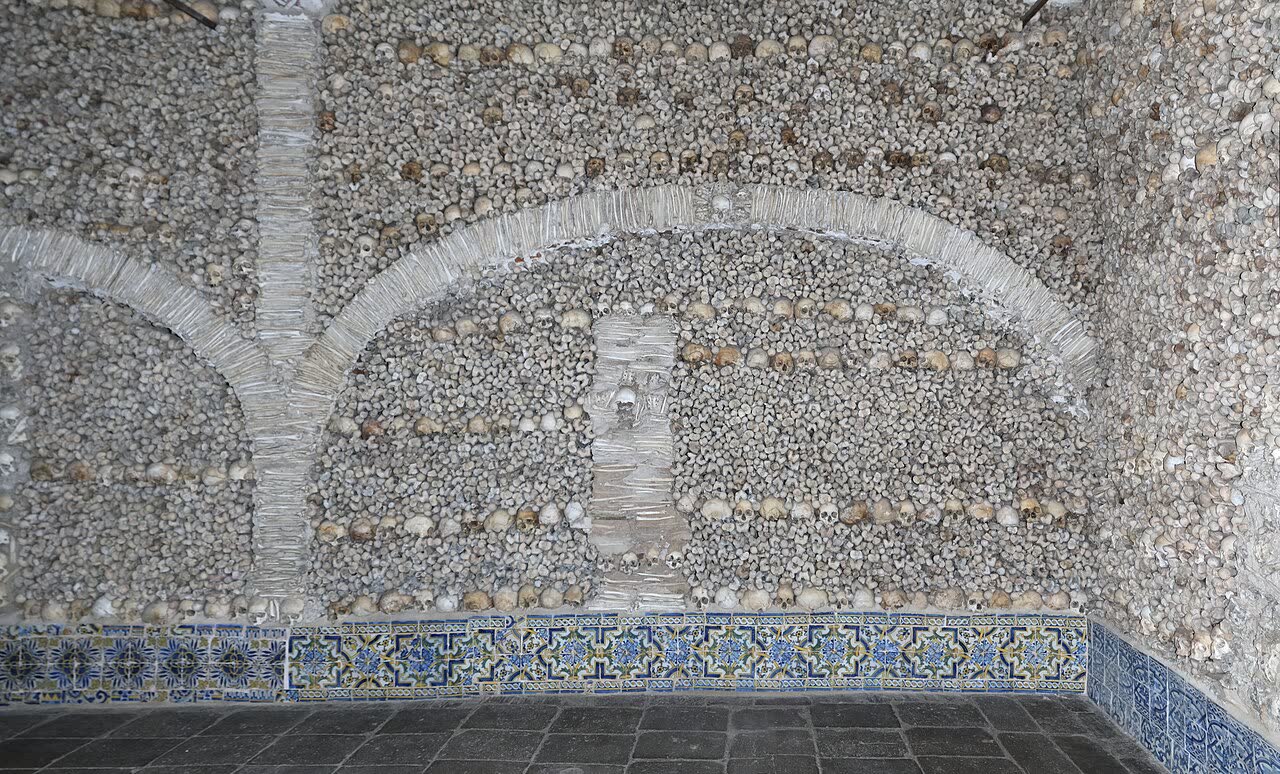
The Chapel of Bones in Évora is one of Portugal’s most unforgettable sights: a small chapel whose walls and pillars are lined with thousands of human skulls and bones. It’s eerie, fascinating and surprisingly peaceful. Here’s how to visit, and what else to see in Évora.
Quick answer: the Capela dos Ossos is part of the Church of São Francisco in central Évora. Allow 45 minutes including the church and museum. Évora is about 1.5 hours from Lisbon by train, bus or car, so it’s an easy day trip. See Évora day trips from Lisbon.

Why go
Few places make you stop and think quite like this one. The chapel is small, but every surface is covered in bones set in neat patterns, and the effect is more calm than creepy. Add a Roman temple, a Gothic cathedral and a whitewashed old town, and Évora makes one of the best day trips from Lisbon. The whole historic centre has been a UNESCO World Heritage Site since 1986, and almost everything worth seeing is within a 15-minute walk of the main square.
About the chapel
Franciscan monks built the chapel in the 16th century, using bones from overcrowded local cemeteries. Their purpose was to make people reflect on the shortness of life. Over the entrance, an inscription reads (in translation), “We bones that are here are waiting for yours.” Inside, look for the painted ceiling with religious scenes and the poem on the wall about death and vanity.
The bones are usually said to come from about 5,000 people. Skulls line the arches and window frames, while long bones are stacked in rows between them, held in place with mortar. Look out too for the two dried bodies, one of them a small child, hanging on one wall.
What to see
- The chapel: walls and columns patterned with skulls and bones. It takes about 15 minutes to take it in.
- The Church of São Francisco: a large Gothic-Manueline church with a wide single nave and gilded side chapels. Look for the royal emblems over the door: kings used to stay in a palace next door.
- The museum and terraces above, with sacred art and views over Évora’s rooftops.
- The nativity scene collection: hundreds of crib scenes from around the world, included in the ticket.
Tickets and hours
The chapel is usually open daily from 9am, until about 6:30pm in summer and 5pm in winter. It closes on a few holidays, including 1 January, Easter Sunday, the afternoon of 24 December and Christmas Day. A ticket costs a few euros, with discounts for young people and seniors, free entry for young children and a family ticket. You buy it at the desk by the church entrance, and there’s normally no need to book. Check times before you go, especially around religious holidays.
Queues are rare outside the middle of the day. Tour groups from Lisbon tend to arrive late morning, so the first hour after opening and the last hour before closing are the quietest.
Getting to Évora
- By train: CP Intercidades trains run from Lisbon (Oriente and Entrecampos) in about 1 hour 30 to 1 hour 45 minutes. There are only a few trains a day and seats can sell out, so book ahead on the CP website or app. Évora station is a 15 to 20 minute walk from the centre. See day trips from Lisbon by train.
- By bus: Rede Expressos coaches leave from Sete Rios and take about 1.5 to 2 hours. The bus station is just outside the walls, a short walk from the centre. See Portugal by bus.
- By car: about 1.5 hours on the A6 toll motorway. Park outside the walls; driving in the old centre is hard.
See the Évora day trip from Lisbon.
More in Évora
- The Roman Temple: the remarkably intact columns of a 1st-century temple, often called the Temple of Diana. It’s free to see from the street.
- The cathedral: a fortress-like Gothic cathedral with a cloister. Climb to the roof for views. Allow about 45 minutes.
- Praça do Giraldo: the main square, full of cafés, with arcades and a marble fountain.
- The aqueduct with houses built into its arches. Follow it along Rua do Cano in the north-west of the old town.
- Alentejo food and wine. See Alentejo wine tours.
- The Almendres Cromlech: a prehistoric stone circle outside town, with nearly 100 standing stones on a hillside among cork oaks. You need a car or a tour to get there; the last stretch is a dirt road.
A one-day route
Arrive mid-morning and start at the Roman Temple and the cathedral roof. Walk down to Praça do Giraldo for lunch, then visit the Chapel of Bones in the early afternoon. Finish with a walk along the aqueduct and a glass of Alentejo wine before the train back.
Food
- Porco preto: black Iberian pork, grilled or in stews.
- Açorda alentejana: bread soup with garlic, coriander and a poached egg.
- Migas: fried bread crumbs, often served with pork.
- Sericaia: a light egg pudding served with plums from nearby Elvas.
Lunch is the main meal here, and many restaurants close between about 3pm and 7pm, so don’t leave it too late. See Alentejo food.
Tips
- Respect: it’s a religious site, so keep your voice down.
- Kids: some children find it fascinating, others may find it frightening.
- Summer heat: Évora is very hot in July and August. Visit early.
- When to go: spring and autumn are the most comfortable. Évora is a European Capital of Culture in 2027, so expect more events and visitors that year.
- Stay over: Évora is lovely in the evening. See where to stay in Évora.
FAQ
How long do you need at the Chapel of Bones?
About 15 minutes for the chapel itself, or around 45 minutes if you also see the church, the museum, the terraces and the nativity scenes.
Do you need to book tickets?
Usually not. You buy tickets at the desk on the day, and queues are short outside the late-morning rush.
Is the Chapel of Bones suitable for children?
Young children get in free, and many find it fascinating. Some find the skulls and the two hanging bodies upsetting, so tell them what to expect before you go in.
Can you visit Évora as a day trip from Lisbon?
Yes. Trains, buses and the drive all take about 1.5 hours, which leaves time for the chapel, the Roman Temple, the cathedral and lunch.
More: the best day trips from Lisbon and UNESCO sites in Portugal.
See also: Évora 2027, European Capital of Culture.
Some links in this guide are affiliate or referral links (GetYourGuide, Booking.com, Discover Cars, Welcome Pickups, Airalo, Yesim, Saily, Tiqets, Radical Storage, EKTA, AirHelp, Uber). If you book or sign up through them we may earn a small commission or ride credit at no extra cost to you. It helps keep our groups and this site free.
Still got questions?
Ask 305,000+ travellers and locals in our free Facebook groups.