
Capela das Almas, Porto: Tiles, History and Visiting Tips
The Capela das Almas is the small chapel on Rua de Santa Catarina whose outside walls are covered from pavement to roofline in blue-and-white tiles. It stands on Porto’s busiest shopping street, a block from the Bolhão market, so plenty of people walk past without looking up. Here’s who made the tiles, what the scenes show and how to visit.
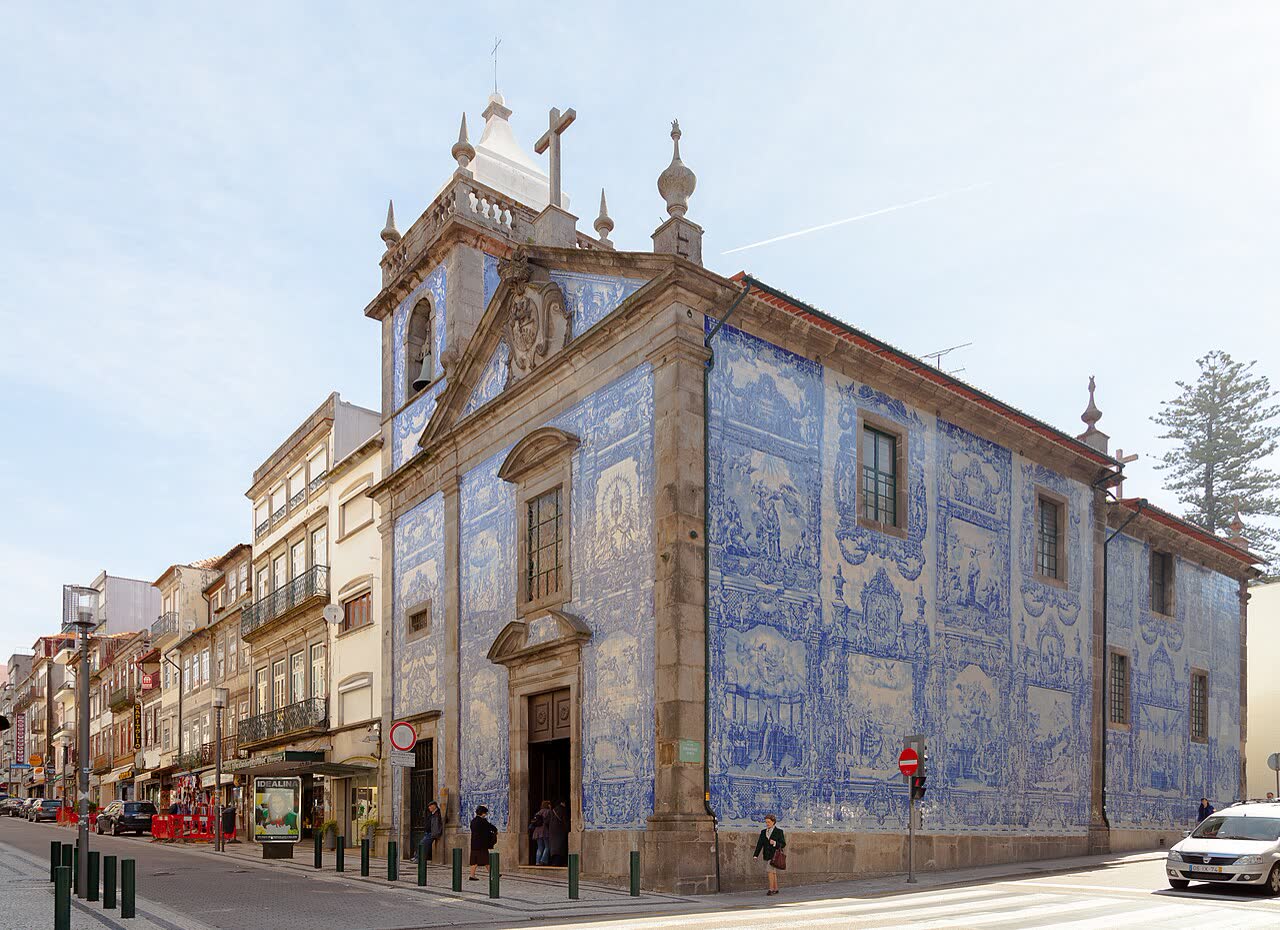
Quick answer: the Capela das Almas is free to see and to enter. Its front and side wall carry 15,947 tiles, about 360 square metres, designed by Eduardo Leite and made in 1929 at the Viúva Lamego factory in Lisbon. They show the lives of St Francis of Assisi and St Catherine. Allow 15 minutes, come in the morning for the best light, and pair it with the Bolhão market.

Where it is
The chapel sits on the corner of Rua de Santa Catarina and Rua Fernandes Tomás in the Baixa, at Rua de Santa Catarina 428. Bolhão metro station and the market are a couple of minutes’ walk away. It’s also called the Capela de Santa Catarina, or the Chapel of Souls.
A short history
The site began as a wooden chapel to St Catherine, which gave the street its name. Then a lay brotherhood, the Irmandade das Almas e das Chagas de São Francisco (Brotherhood of the Souls and the Wounds of St Francis), moved here from the Monastery of Santa Clara. The crowds it drew called for a bigger church, and the brotherhood’s “souls”, the souls in purgatory, gave the chapel its everyday name.
Sources disagree on the date. Visit Porto and Portugal’s national art inventory say the early 18th century, while a book on the chapel dates the present building to the late 18th century. Either way, the outside was plain whitewashed plaster until 1929, when the brotherhood followed the fashion set by the Igreja do Carmo’s tile wall.
The tiles: who, when and how many
- Designer: Eduardo Leite, a Sintra-born painter then in his twenties, who also managed the factory that made them.
- Factory: the Fábrica de Cerâmica Viúva Lamego in Lisbon.
- Count: 15,947 tiles over about 360 square metres of wall. Many guides round it to 16,000.
- Style: a baroque revival in the manner of 18th-century tiles, with painted columns, garlands and cherubs framing each scene.
- Restoration: by 1980, when National Geographic printed the whole side wall in colour, the tiles were in poor shape. In late 1982 restorers lifted and reset 2,400 of them, and Viúva Lamego made 28 new tiles to replace ones that had fallen and smashed in the street.
What the tiles show
The scenes tell the chapel’s story: St Catherine, St Francis, the souls in purgatory and the Eucharist. Many have captions, so start at the front and walk down the side wall.
- The front: St Francis receiving the stigmata, the wounds of Christ, matched by the Coronation of St Catherine. There’s also St Francis with the souls in purgatory, and two kneeling angels holding up a monstrance, ringed by the words Bendito e louvado seja o Santíssimo Sacramento da Eucaristia (blessed and praised be the Most Holy Sacrament).
- The side wall, St Francis: preaching before Pope Honorius III, Christ reaching down from the cross to embrace him, water springing from a rock, his death, and angels carrying him into heaven.
- The side wall, St Catherine: an angel announcing her victory, her debate with the scholars of Alexandria, and her last prayer before she was beheaded.
Visiting inside
Entry is free. It’s a working church, plainer inside than out, but look for these.
- High altar: a painting of the Ascension, the chapel’s main feast, by the Porto painter Joaquim Rafael, from 1815.
- Stained glass: the big window above the door, signed by Amândio Silva. It shows Christ’s arm nailed to the cross, with drops of blood falling on the souls in purgatory.
- Tiles and statue: three more St Francis tile panels, and the 18th-century image of Nossa Senhora das Almas (Our Lady of the Souls).
Opening times vary between listings and none is dated for 2026, so check the notice by the door. Services always come first.
- Dress: cover shoulders and knees, and take hats off.
- During Mass: don’t walk around or take photos. Sit quietly at the back or come back later.
- Photos: no flash, and leave people praying out of your shots.
Photo tips
- Best light: the front faces west, so it’s in shade in the morning and the blue looks even. From mid-afternoon the sun hits it and the glaze glares. The side wall faces south and gets sun most of the day, so a cloudy day suits it best.
- Whole front: stand on the far side of Rua de Santa Catarina with a wide lens to fit in the bell tower on the left.
- Side wall: shoot down Rua Fernandes Tomás from the corner.
- Crowds: Santa Catarina fills with shoppers from mid-morning, so early morning is quietest. See Porto’s best photo spots.
What’s nearby
- Bolhão Market: a block west along Rua Fernandes Tomás, closed on Sundays and public holidays. See our Bolhão Market guide.
- Rua de Santa Catarina: the main shopping street runs south from here. See shopping in Porto.
- Majestic Café: about five minutes south, open since 1922. Expect a queue. See the Majestic Café guide.
- Igreja de Santo Ildefonso: at the southern end of the street by Praça da Batalha, with about 11,000 tiles by Jorge Colaço, added in 1932.
- São Bento station: about 20,000 tiles by Colaço, free to see, about 10 minutes’ walk downhill. See the São Bento guide.
- Igreja do Carmo: the 1912 tile wall that set the fashion in Porto, about 15 minutes’ walk west. See the Igreja do Carmo guide.
FAQ
Is the Capela das Almas free to visit?
Yes. The tiled walls are free to see from the street at any time, and there’s no charge to go inside when the chapel is open.
How many tiles are on the Capela das Almas?
There are 15,947, covering about 360 square metres of the front and side wall. Eduardo Leite designed them, and they were made in 1929 at the Viúva Lamego factory in Lisbon.
What do the Capela das Almas tiles show?
Scenes from the lives of St Francis of Assisi and St Catherine of Alexandria, plus the souls in purgatory and the Eucharist.
Can you go inside the Capela das Almas?
Yes. It’s a working church, open to visitors outside services. Dress modestly and keep out of the way during Mass.
More: Porto’s most beautiful churches, a guide to azulejos and the Baixa.
Prices and details change, so please double-check before you travel. Spotted something out of date? Tell us in the groups.
Still got questions?
Ask 305,000+ travellers and locals in our free Facebook groups.