
Sao Bento Station: Porto's Tiled Railway Station
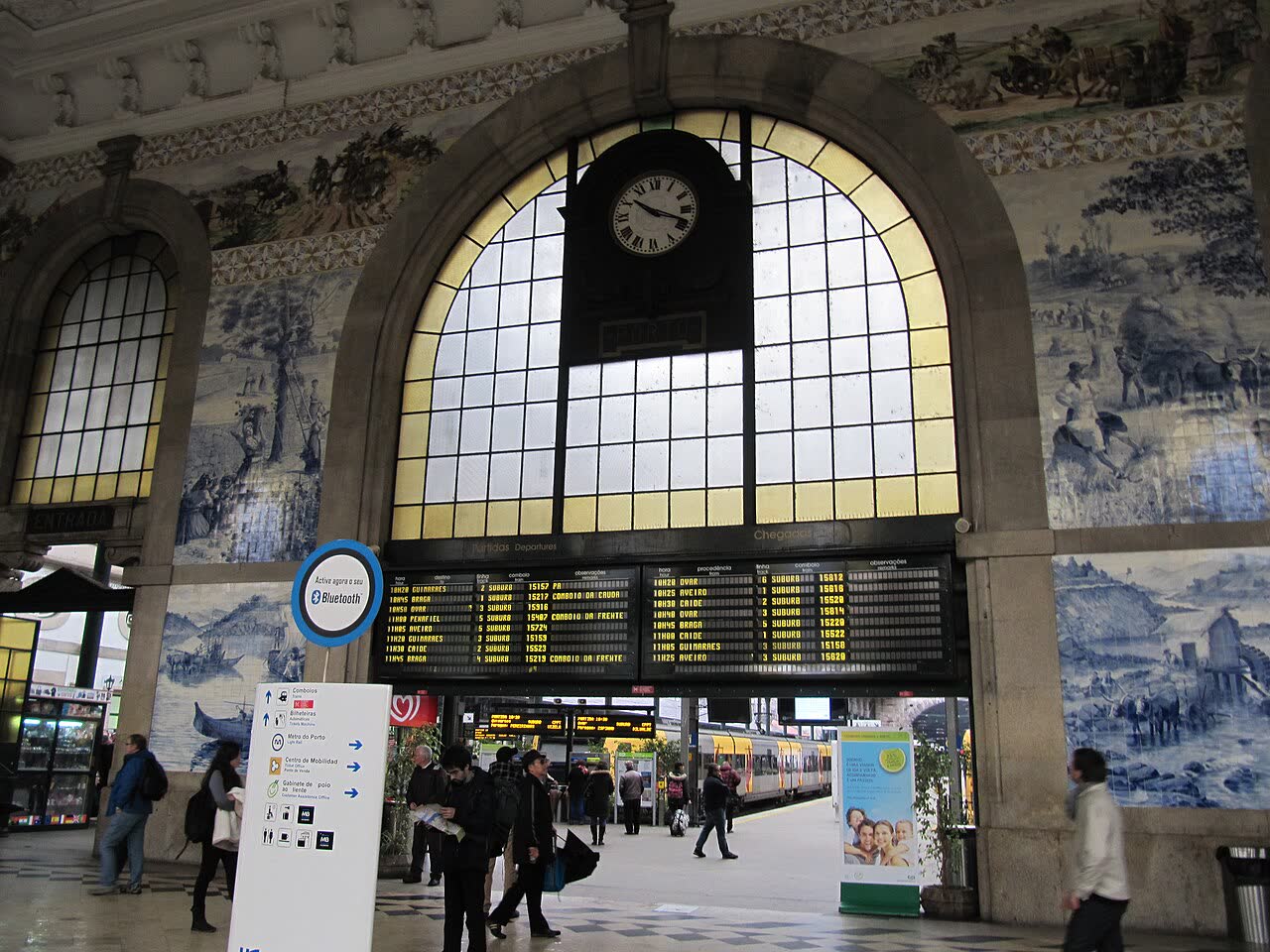
São Bento is often called one of the most beautiful railway stations in the world. Its grand entrance hall is covered in about 20,000 blue-and-white azulejo tiles telling the story of Portugal. And it’s free to visit. Here’s what to look for, and where you can take a train from here.
Quick answer: São Bento is in the centre of Porto, at the bottom of Avenida dos Aliados. The entrance hall is free to visit any time the station is open, and 10 to 20 minutes is enough. Go early morning for photos without crowds. Trains leave from here for the Douro Valley, Braga, Guimarães and Aveiro.
_(14004154641).jpg)
Why go
You don’t need a ticket or a train to enjoy São Bento. Walk in from the street and the whole entrance hall is wrapped in huge tile pictures, from royal weddings and battles to farmers bringing in the harvest. It’s one of the best free sights in Porto, it’s right in the centre, and it’s also a working station you’ll probably use for a day trip.
About the station
The station stands on the site of a Benedictine convent, São Bento de Ave-Maria, which gives it its name. The convent was founded in the early 16th century and demolished in the 1890s. The first trains arrived at a temporary station here in 1896, and the present building, designed by the Porto architect José Marques da Silva in a French Beaux-Arts style, was inaugurated in 1916.
The tile panels were painted by the artist Jorge Colaço between about 1905 and 1916. They cover roughly 550 square metres of wall.
Getting trains into the city centre was a big engineering job. The tracks reach São Bento through a tunnel from Campanhã, which is why the platforms sit in a cutting behind the hall rather than out in the open.
What the tiles show
- Historic scenes: great moments in Portuguese history, including the conquest of Ceuta in 1415 and the arrival in Porto of King João I and Philippa of Lancaster.
- Medieval stories: the Battle of Arcos de Valdevez and the knight Egas Moniz offering his life to the King of León to keep his word.
- Everyday life: scenes of rural life in northern Portugal, such as harvests, vineyards, festivals and pilgrimages.
- The frieze: a coloured band near the ceiling showing the history of transport.
Stand in the middle of the hall and turn slowly. Then step close to one panel to see the brushwork on each tile. See azulejos in Portugal.
How to read the hall
The big blue panels are the historic and religious stories, and they’re best seen from a few steps back. The smaller scenes of country life are easier to study up close: look for ox carts, grape pickers and people in regional dress. The transport frieze runs in a loop above them, so you can follow it around the room from early carts to the arrival of the railway.
Visiting tips
- Cost: free. You only need a ticket if you’re taking a train.
- Timing: early morning is the quietest. Midday brings tour groups.
- Be considerate: it’s a busy commuter station, so keep clear of people rushing for trains when you stop for photos.
- Look up: the colour frieze and the ceiling are easy to miss.
- Getting there: the São Bento metro stop on line D (yellow) is next door, and it’s a short walk from Ribeira, the cathedral and Aliados.
- Pickpockets: busy stations attract them, so keep your phone and wallet close while you take photos.
- Building work outside: the new Pink line (Linha Rosa) of the metro is being built from São Bento towards Casa da Música. Opening has been planned for early 2027, so expect some work and traffic changes around the square until then.
Photography tips
- Wide shots: stand near the entrance and shoot back into the hall to get several panels and the ceiling in one frame.
- Details: a close-up of a single face or horse often looks better than a crowded wide shot.
- Light: the hall is fairly dim, so hold your phone steady. Avoid flash, which bounces off the glazed tiles.
Trains from São Bento
São Bento is a terminus for CP urban and regional trains. Most trains also call at Campanhã, Porto’s main station, a few minutes away. Buy tickets at the machines or ticket office, and check the departure boards, as some services start from Campanhã instead.
- The Douro line to Peso da Régua and Pinhão. See the Douro itinerary.
- Braga and Guimarães. See Braga and Guimarães.
- Aveiro. See Aveiro.
- Long-distance trains to Lisbon leave from Campanhã, one stop away. See Lisbon to Porto by train.
The Douro line is being electrified in stages. Trains between Marco de Canaveses and Régua were replaced by buses from November 2025 to April 2026, and more closures are possible while the work goes on. Check the CP website for the current timetable before you plan a Douro day trip.
See day trips from Porto by train.
A half-day route from the station
Start inside São Bento with the tiles. Walk up Avenida dos Aliados to the city hall, then loop back past the Clérigos Tower and Livraria Lello. Climb up to the cathedral terrace for the view, then walk down Rua das Flores to the river at Ribeira for lunch. Allow three to four hours with stops.
Nearby
- Avenida dos Aliados and the city hall.
- Rua das Flores down to Ribeira.
- The cathedral on the hill above.
- Igreja de Santo Ildefonso and its tiles. See Porto’s churches.
- Baixa: shops, cafés and the Bolhão market are a short walk uphill. See Baixa.
FAQ
Is São Bento station free to visit?
Yes. The tiled entrance hall is free and open whenever the station is open. You only pay if you catch a train.
How long do you need at São Bento?
Ten to twenty minutes is enough to see the tiles properly. Allow a little longer if you want photos without people in them.
Who painted the tiles at São Bento?
Jorge Colaço painted the panels between about 1905 and 1916. They show scenes from Portuguese history and everyday life in the north.
Can you get a train to the Douro Valley from São Bento?
Yes, Douro line trains to Régua and Pinhão leave from São Bento or Campanhã. Engineering work sometimes affects the line, so check CP times first.
More: Porto’s best photo spots and free things to do in Porto.
See also: luggage storage in Lisbon and Porto.
Prices and details change, so please double-check before you travel. Spotted something out of date? Tell us in the groups.
Still got questions?
Ask 305,000+ travellers and locals in our free Facebook groups.