
Trip guides / Sintra and Cascais
Sintra Pastries: Travesseiros, Queijadas and Where to Buy
Sintra is famous for its palaces, but plenty of visitors remember the pastries just as well. The town has two of its own: the travesseiro, a puff pastry filled with egg and almond cream, and the queijada, a small, sweet cheese tart. Here’s what they are, where they come from and where to buy them.
Quick answer: try a travesseiro (flaky puff pastry with an egg and almond filling) and a queijada (a little tart of fresh cheese, sugar, egg and cinnamon). The classic place is Casa Piriquita on Rua das Padarias, open since 1862, where the travesseiro was created in the 1940s. For queijadas, also try Queijadas da Sapa on Volta do Duche. Expect to pay about €2 for a travesseiro and a little less for a queijada.
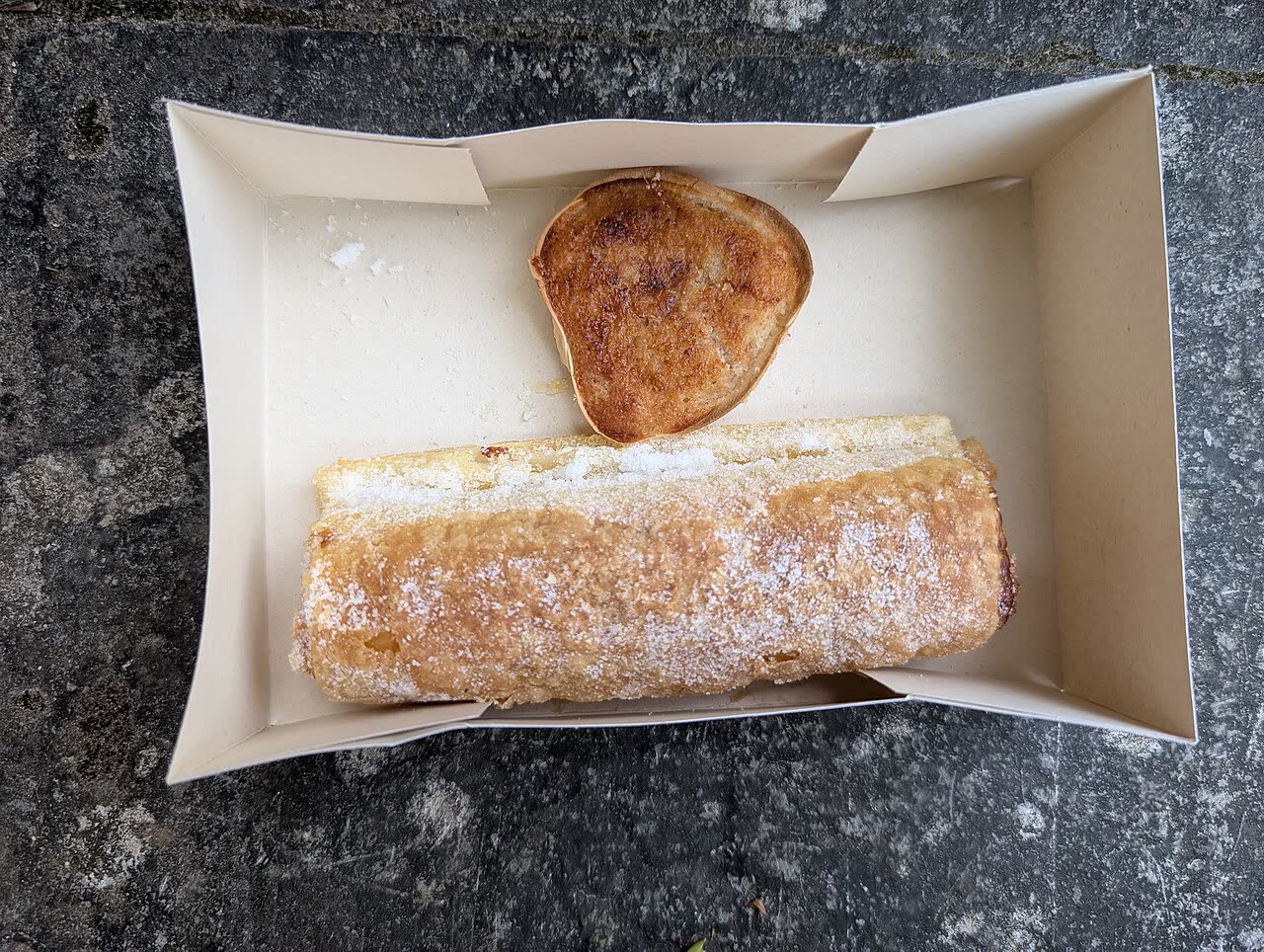

The travesseiro
Travesseiro means “pillow”, and the pastry is shaped like a small one, dusted with sugar. It’s the one most people queue for.
- The pastry: thin layers of puff pastry that flake as you bite, so expect crumbs on your clothes.
- The filling: a cream of egg, almond and sugar. Piriquita says its version also has a secret ingredient, and only the family knows the recipe.
- The taste: crisp outside, soft and creamy inside, and sweet. It’s best warm, straight from the counter.
Where it came from
Piriquita says the travesseiro was created in the 1940s, during the Second World War, when the bakery needed something new. Constança Luísa Cunha, from the founding family, is said to have found the recipe in an old cookbook. The filling recipe has stayed in the family ever since.
The queijada
The queijada is Sintra’s older sweet. It’s a small, round tart with a thin, crisp pastry case and a dense filling of fresh cheese, sugar, eggs, a little flour and cinnamon.
- The taste: sweet rather than tangy, with a hint of cinnamon. Some visitors find it very sweet, so a coffee helps.
- How it’s sold: singly or in packs of six, which travel well.
- Other queijadas: Madeira, the Azores and Évora have their own versions. See Portuguese desserts.
A long history
Sintra’s official tourism site dates the queijada back to the 13th century, when it was used to help pay rents. Queijadas were made at home until the mid-18th century, when bakeries began making them to sell. The best-known early name is Maria Sapa, who settled in Ranholas, near Sintra, in 1756 and is credited with starting commercial production. Piriquita’s own story says King Carlos I, who spent his summers in Sintra, encouraged its founders to make them.
Casa Piriquita
Piriquita opened as a bakery in 1862, run by the baker Amaro dos Santos and his wife, Constância Gomes. The story goes that King Carlos I nicknamed her “Piriquita” because she was so small, and the name stuck. The family still runs it, now in its fifth generation.
- Piriquita I: the original shop at Rua das Padarias 1, about two minutes’ walk from the National Palace. It usually has the longest queue. Open daily from 8:30am to 7pm (7:30pm at weekends and on holidays).
- Piriquita II: a few doors up the same street, at number 18, with more seating. Open daily from 10am to 6pm (10:30am to 6:30pm at weekends and on holidays).
- What else to try: pastel de Sintra, noz dourada and pastel da Cruz Alta (see below), plus a Nutella version of the travesseiro.
- In Lisbon: Piriquita also has a shop on Avenida de Roma and a counter in El Corte Inglés.
Times are from Piriquita’s website in October 2026, so check before you go.
Queijadas da Sapa
The other historic name is the Fábrica das Verdadeiras Queijadas da Sapa (the “factory of the real Sapa queijadas”), which traces its story back to Maria Sapa in 1756. After the railway reached Sintra’s Estefânia district in 1887, Ranholas was no longer the way into town, and production moved to Volta do Duche, where it still is today.
- Where: Volta do Duche 12, on the road you walk along from the station into the old town, with a view across to the National Palace.
- What to order: queijadas, of course. There’s a tea room if you want to sit down.
- When: usually closed on Mondays. Listed hours vary, so check before you go.
- Literary fame: the house says its queijadas appear in the writing of Eça de Queirós and Ramalho Ortigão, two well-known 19th-century Portuguese writers.
Other Sintra sweets
- Pastel de Sintra: egg and almond cream in crisp puff pastry, made by Piriquita.
- Pastel da Cruz Alta: egg cream, almond and white beans in puff pastry, named after Cruz Alta, the highest point in the Sintra hills.
- Noz dourada: the “golden walnut”, a small cake of walnut, almond and egg sweet coated in caramel. It comes from the village of Galamares, near Sintra, and is now rare. Piriquita still makes it.
- Fofos de Belas: small sponge cakes filled with custard, made in the town of Belas, also in the Sintra area, since 1850.
Prices in 2026
- Travesseiro: about €2 each at the counter. Piriquita’s website lists a box of four for €8.80 and six for €13.20.
- Queijada: usually about €1.30 to €1.80 each, or €7.50 for a pack of six on Piriquita’s website.
- Other cakes: pastel de Sintra and noz dourada work out at about €2 each in boxes.
- Coffee: an espresso usually adds about €1 to €1.50. See the Portuguese coffee guide.
Prices can rise a little in summer, so treat these as a guide.
Queues and timing
- Busiest: from about 10:30am to 3:30pm, and especially at lunchtime in July and August, when the queue at Piriquita can spill into the street.
- Quietest: first thing, before about 10am, or after 5pm.
- It moves fast: the queue looks long, but the staff are used to it and it usually moves quickly.
- Try the other shop: if Piriquita I is packed, walk up to Piriquita II.
Fitting it into a day trip
Most people combine the pastries with the palaces:
- Walking in: if you walk from the station into town, Sapa is on the way. Stop for a queijada and a coffee.
- Going up the hill: if you take the 434 bus straight up to Pena, buy pastries on the way back down. They’re best fresh.
- Lunch or late afternoon: stop at Piriquita between sights, or at the end of the day before the train back. See Sintra in one day.
- On a tour: many group tours include free time in the old town. See the best Sintra tours.
- Taking some home: travesseiros are best eaten the same day. Queijadas keep for a day or two in their packet.
FAQ
What is a travesseiro?
A Sintra pastry of puff pastry wrapped around an egg and almond cream, dusted with sugar. The name means “pillow”. It was created at Casa Piriquita in the 1940s.
What is the difference between a travesseiro and a queijada?
A travesseiro is flaky puff pastry with an egg and almond filling. A queijada is a small cheese tart with a crisp case and a touch of cinnamon.
Where is the best place to buy travesseiros in Sintra?
Casa Piriquita on Rua das Padarias, where the travesseiro was created, is the classic choice. Other bakeries in town sell them too, and Piriquita II, a few doors up, is often quieter.
How much is a travesseiro at Piriquita?
About €2 each in 2026. Piriquita’s website lists a box of four for €8.80.
Can you buy Sintra pastries in Lisbon?
Yes. Piriquita has a shop on Avenida de Roma and a counter in El Corte Inglés, both in Lisbon.
More: visiting Sintra, Lisbon to Sintra and the best pastel de nata in Lisbon.
Prices and details change, so please double-check before you travel. Spotted something out of date? Tell us in the groups.
Still got questions?
Ask 305,000+ travellers and locals in our free Facebook groups.