
Trip guides / Sintra and Cascais
Praia da Ursa, Sintra: The Path Down, Safety and Tips
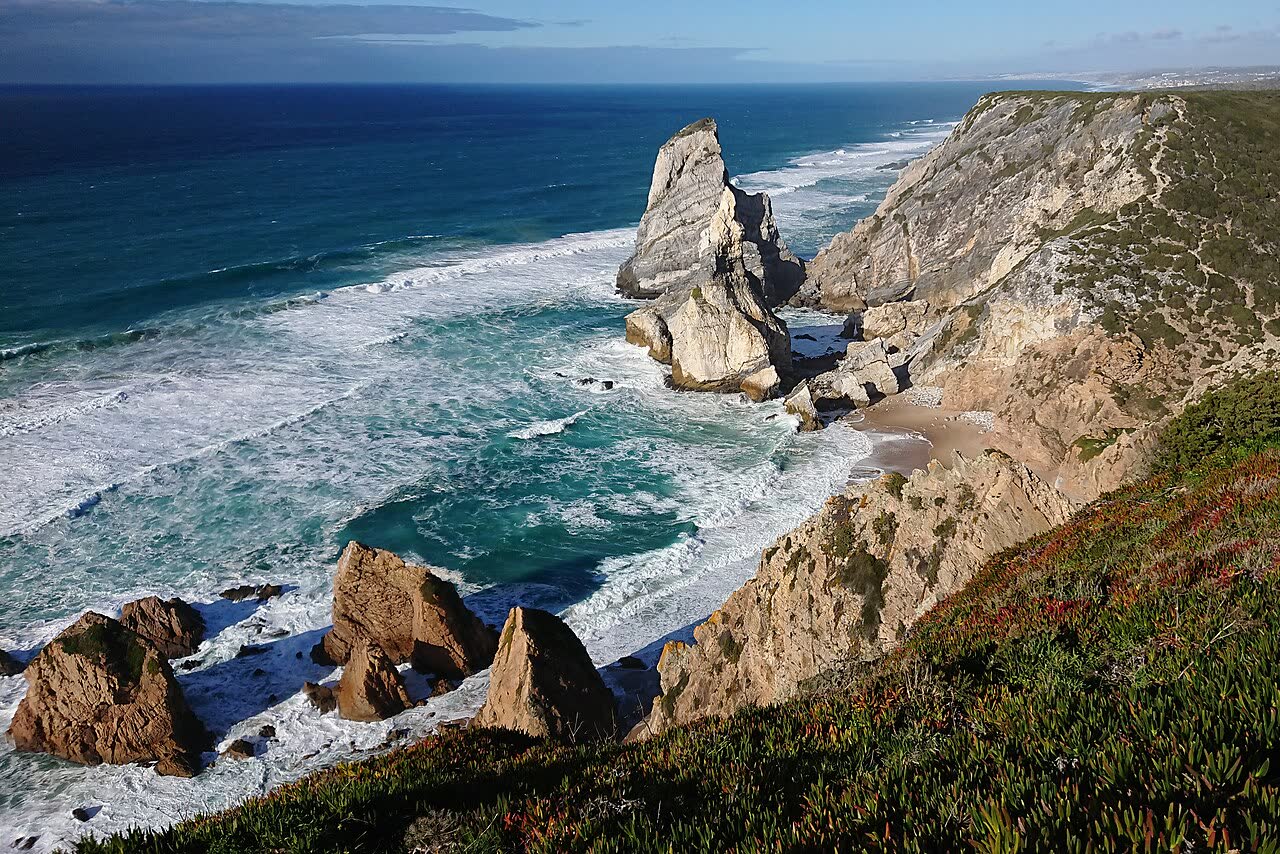
Praia da Ursa is a wild beach on the Sintra coast, just north of Cabo da Roca, the westernmost point of mainland Europe. Tall sea stacks rise from the surf, cliffs close it in on the land side, and the only way down is a steep, loose path. Here’s what the walk is like, how to stay safe and when to go.
Quick answer: the path to Praia da Ursa leaves the road to Cabo da Roca and is about 2.6km there and back. The first part is easy, but the last 400m drop steeply down the cliff on loose ground. There are no lifeguards, toilets or cafés, it isn’t an official bathing beach, and Sintra council advises against going down. Go only on a dry, calm day, wear proper shoes and don’t swim when there’s any swell.

Why go
Ursa is one of the wildest beaches near Lisbon. There are no buildings, roads or beach bars, just sand, boulders and a row of rock pillars standing in the Atlantic. It lies inside the Sintra-Cascais Natural Park, so the clifftops above are open heath. On a clear day the view from the top is reason enough to walk out, even if you decide not to go down.
It pairs naturally with a stop at Cabo da Roca, a short walk south along the cliffs.
What makes it special
- The bear rock: the beach takes its name from a large rock on the sand that is said to look like a bear (ursa in Portuguese). The tall rock beside it is known as the Gigante, or giant.
- The sea stacks: pillars and boulders run out into the surf, and they look different with every tide.
- The viewpoint: the clifftop at the top of the descent looks straight down over the beach. See Sintra’s best photo spots.
- No development: no car park, no café and no lifeguard tower, which is part of the appeal and also the main risk.
The path down
The path starts on the road to Cabo da Roca, a few dozen metres before the cape. It’s about 1.3km each way, or 2.6km there and back. The first 900m or so cross the clifftop and are easy. The last 400m are the hard part: a steep, winding descent down the cliff on loose stones and sand.
The route isn’t properly signposted, so save it in a map app before you set off. Wear trainers or walking shoes with grip, not flip-flops, and keep your hands free. Children will need help on the steep section. Don’t go down in or after rain, when the ground turns slippery.
The climb back up is harder than the descent, especially in the afternoon heat. If the last section looks too much, stop at the viewpoint at the top. You still see the stacks and the whole beach from there.
Safety
Portugal’s environment agency (APA) says Ursa has never been suitable for bathing, and it isn’t on the official 2026 list of bathing waters. That means no lifeguards at any time of year. Sintra council advises against going down to the beach and staying there, for safety reasons.
- Rockfalls: in March 2018 a rockfall on the beach killed one person and injured another. Don’t sit or shelter right under the cliffs.
- The sea: this is the open Atlantic, with strong currents and swell, and the rocks make it worse when the waves are up. Only paddle on a calm day, and don’t swim out.
- Rescues: emergency services, sometimes with a helicopter, have had to rescue people who fell or lost their way on the paths around the beach.
- Before you go: tell someone your plans, take a charged phone and call 112 in an emergency.
Getting there
- By car: about 20 minutes from Sintra or Cascais, and roughly 45 minutes from central Lisbon, traffic allowing. See car hire in Portugal.
- By bus: the old 403 bus has been withdrawn. Carris Metropolitana bus 1253 runs to Cabo da Roca from Sintra station, and the 1624 between Cascais and Portela de Sintra station stops at the cape in the daytime. From the bus stop, walk back along the road to the start of the path. Check the timetable for the last bus back.
- From Lisbon: take the train to Sintra or Cascais, then the bus. See Lisbon to Sintra.
- On a tour: many Sintra and Cascais day trips stop at the cape, though they rarely leave time for the walk down. See tours that include Cabo da Roca.
Parking
Most people use the free car park at Cabo da Roca, which fills by late morning in summer. From there it’s a short walk back along the road to the path. Don’t park where you block the road or a gateway, and leave nothing on show in the car.
Facilities
There are none on the beach: no lifeguards, toilets, café, shade or bins. The nearest cafés and toilets are at Cabo da Roca. Bring:
- Plenty of water and some food.
- A windproof layer, as the coast here is often windy and cooler than Lisbon.
- A bag to take your rubbish home.
When to go
- Calm, dry days: the most important thing. Skip it in rain, strong wind or big swell.
- Around low tide: there’s more sand and more room to walk among the rocks. Check today’s tide times for nearby Guincho on tides.watch.
- Late afternoon: the beach faces the open ocean to the west, so the low sun lights up the stacks. Leave plenty of time to climb back before dark.
- Spring and early autumn: cooler for the climb. Winter storms make the beach dangerous.
See the best sunset spots in Portugal.
Tips
- Children: not suitable for small children. For an easier family beach, try Praia das Maçãs. See Sintra’s beaches.
- Naturists: some visitors sunbathe nude here, so expect that on quiet days.
- The rocks: don’t climb the stacks or the cliffs, and watch for waves breaking over the lower rocks.
- Combine it: visit Cabo da Roca and its lighthouse, then drive on to Azenhas do Mar or south to Guincho.
- More walks: see Sintra’s hiking trails.
Plan it: Sleep nearby for an early start before the crowds and the heat: see places to stay in Sintra, or base yourself by the sea and find a place to stay in Cascais. See also where to stay in Sintra and Sintra and Cascais in one day.
FAQ
How long is the walk to Praia da Ursa?
About 1.3km each way, or 2.6km there and back, from the road to Cabo da Roca. The first part is easy, but the last 400m are a steep, loose descent, and the climb back takes more effort.
Can you swim at Praia da Ursa?
It isn’t an official bathing beach and has no lifeguards. The currents are strong, so don’t swim when there’s any swell. For a lifeguarded beach nearby in summer, choose Adraga, Praia Grande or Praia das Maçãs.
Can you get to Praia da Ursa by bus?
Yes, to the start of the walk. Bus 1253 from Sintra station and bus 1624 from Cascais stop at Cabo da Roca, and the path leaves the road a few dozen metres before the cape.
Is Praia da Ursa suitable for children?
Not for small children. The last section of the path is steep and loose, and there are no lifeguards. Older children who are used to walking can manage it with help, or you can stop at the viewpoint.
More: the best beaches near Lisbon, things to do in Sintra and the best beaches near Cascais.
Some links in this guide are affiliate or referral links (GetYourGuide, Booking.com, Discover Cars, Welcome Pickups, Airalo, Yesim, Saily, Tiqets, Radical Storage, EKTA, AirHelp, Uber). If you book or sign up through them we may earn a small commission or ride credit at no extra cost to you. It helps keep our groups and this site free.
Still got questions?
Ask 305,000+ travellers and locals in our free Facebook groups.