
The Aguas Livres Aqueduct, Lisbon
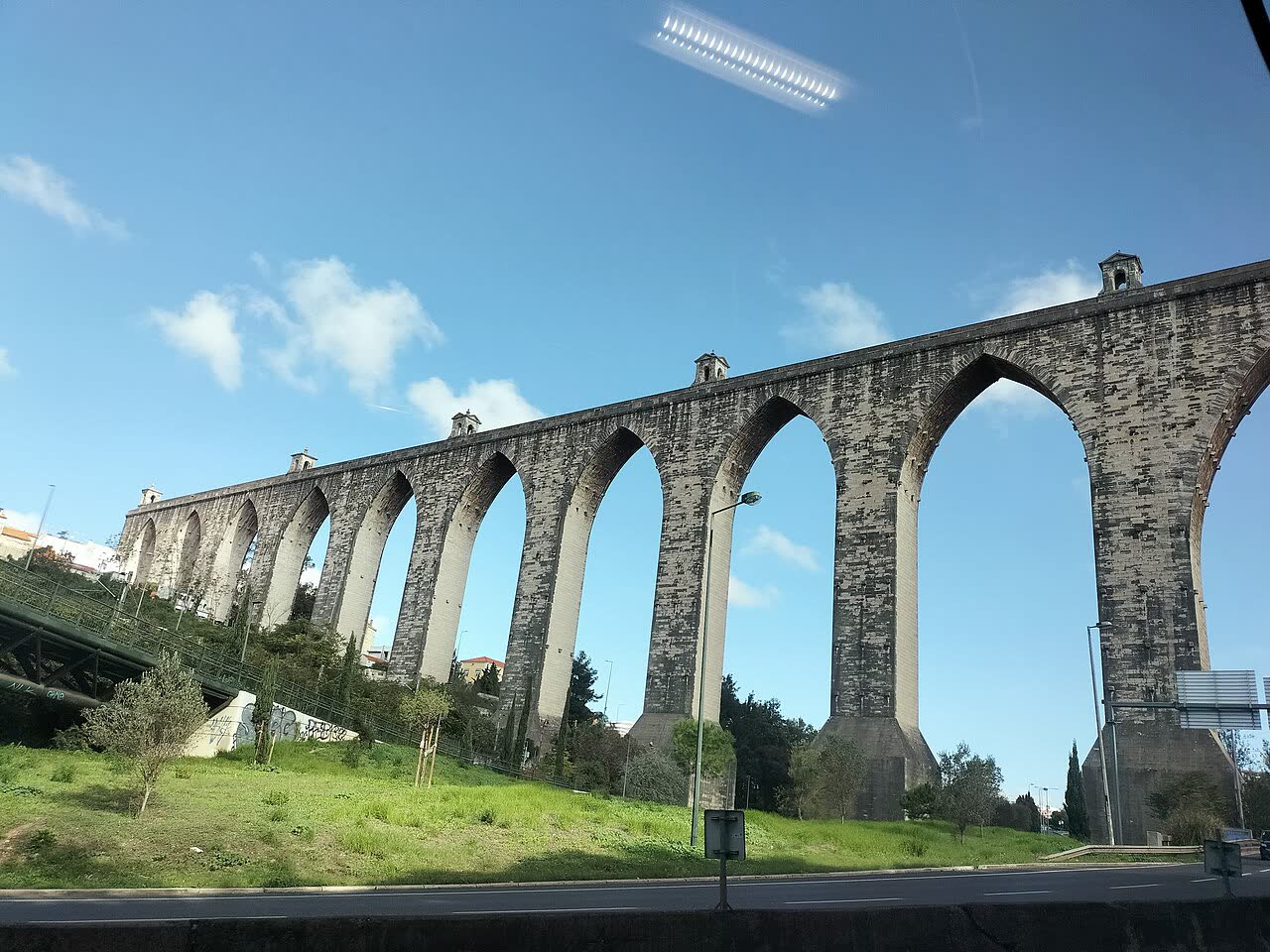
The Águas Livres Aqueduct is one of Lisbon’s great engineering feats: an 18th-century aqueduct whose tall stone arches stride across the Alcântara valley. It survived the 1755 earthquake, and you can walk along the top. The water it carried ended up in the Mãe d’Água reservoir, which is also open to visitors.
Quick answer: walk across the arches over the Alcântara valley (entrance in the Campolide area), then visit the Mãe d’Água das Amoreiras reservoir, a vast stone cistern. Both are run by the water museum, with a small fee. Allow 1 to 2 hours. Check opening days before you go.

Why go
Few visitors make it here, so it is a quiet break from the crowds in the centre. The walk along the top is unlike any other view of Lisbon: you are high above a motorway and a railway, looking out over the valley towards Monsanto park and the river. It is also cheap, and easy to pair with lunch in Campo de Ourique.
About the aqueduct
Lisbon long suffered from a lack of clean water. In 1731, King João V started a vast aqueduct system to bring spring water into the city. The great central arch was finished in 1744 and water began to flow in 1748. Engineers including Manuel da Maia, Custódio Vieira and Carlos Mardel worked on it over the decades, and the wider system was only completed around the end of the 18th century.
The main channel runs for about 14 km, and the full network of branches is close to 58 km. The section over the Alcântara valley is 941 metres long, with 35 arches. The tallest, the Arco Grande, is 65 metres high, one of the tallest pointed stone arches in the world. The structure came through the 1755 earthquake largely intact, and it supplied the city until 1968.
The whole system worked by gravity alone. Water flowed gently downhill from springs north-west of the city, through stone channels inside the aqueduct, to the Mãe d’Água reservoir. From there, smaller galleries carried it to public fountains (chafarizes) around Lisbon, where water carriers filled their barrels and sold it door to door.
You may hear the story of Diogo Alves, a 19th-century robber said to have thrown victims off the aqueduct. The public walkway did close in 1852, but historians say the closure was not linked to his crimes.
What to see
- The arches walk: a stroll along the top of the Alcântara section, with views over the valley and the city. It is flat and takes about 30 to 45 minutes there and back. There are railings, but people who dislike heights may find it unsettling.
- Mãe d’Água das Amoreiras: a cathedral-like reservoir where the water collected. Building began in 1745 and it was only finished in 1834. Inside you see a deep stone tank and a waterfall feature. It sometimes hosts exhibitions and concerts. Climb to the roof for views. Allow about 30 minutes.
- The water museum: the aqueduct and reservoir are two of the museum’s four sites. The others are the Barbadinhos steam pumping station, near Santa Apolónia, and the Patriarcal reservoir under the Príncipe Real garden. See Príncipe Real.
- Guided visits: the museum runs occasional guided tours, sometimes into parts of the system not normally open. These need booking ahead and cost more than a standard ticket.
Getting there
- The arches: the entrance is on Calçada da Quintinha in Campolide. The nearest train station is Campolide, on the Sintra line, followed by an uphill walk. A bus or taxi from the centre is simpler.
- Mãe d’Água: in Praça das Amoreiras, a short walk from Rato metro station (yellow line).
- Between the two: a taxi takes a few minutes. You can also walk, but it is a fair distance through busy streets.
A half-day route
Start mid-morning at the arches. Then take a taxi to the Mãe d’Água and climb to its roof. Walk on to Campo de Ourique for lunch at the market and a look round the neighbourhood. If you still have energy, stroll down to Príncipe Real in the afternoon.
The reservoir has had shorter opening hours than the arches, sometimes mornings only, so if you want to see both, check its times first and visit it early if needed.
Food nearby
There is little to eat right by the arches, so plan lunch elsewhere. The Mercado de Campo de Ourique is the easiest choice, with food counters serving petiscos, seafood and wine. Around Amoreiras and Rato you find cafes and pastry shops for a coffee and a pastel de nata. See Lisbon food markets.
When to go
Spring and autumn are ideal, with mild weather for the exposed walk. Summer afternoons can be very hot on the stone, so go in the morning. Clear winter days give sharp views, but avoid wet and very windy days. Weekday mornings are the quietest time of all.
Tips
- Opening days: the arches walk is usually open Tuesday to Sunday, from 10am to 5:30pm, with last entry at 5pm. It closes on Mondays and some public holidays, so check the water museum’s current times before you go.
- Tickets: prices are low, with discounts for students and seniors, and children usually go free. The Lisboa Card gives a discount, usually 50%.
- Free days: the museum sometimes opens for free on special dates, such as World Water Day in March.
- Weather: the walk is fully exposed. Bring a hat in summer and a jacket on windy days.
- Combine with Amoreiras and Campo de Ourique. See Campo de Ourique.
FAQ
Can you walk on the Águas Livres Aqueduct?
Yes. You can walk along the top of the arches over the Alcântara valley, entering from Calçada da Quintinha in Campolide. It takes about 30 to 45 minutes there and back.
Is the aqueduct open on Mondays?
No. It is usually open Tuesday to Sunday, from 10am to 5:30pm. Check the water museum’s website for holidays and changes.
How tall is the aqueduct?
The tallest arch, the Arco Grande, is 65 metres high. The section over the valley is 941 metres long, with 35 arches.
Is the aqueduct worth visiting?
Yes, if you like history, engineering or unusual views. It is quiet, inexpensive and pairs well with the Mãe d’Água reservoir and Campo de Ourique.
More: unusual things to do in Lisbon and the best museums in Lisbon.
Prices and details change, so please double-check before you travel. Spotted something out of date? Tell us in the groups.
Still got questions?
Ask 305,000+ travellers and locals in our free Facebook groups.